
Macao Steers Economic Diversification in Uncertain Global Era
Recent data from the IMF’s 2026 Article IV Mission highlights the Macao Special Administrative Region (SAR) at a decisive moment in its economic development. While a robust recovery in the gaming and tourism sectors has fuelled recent growth, with real GDP rising by 7.1 percent in the first quarter of 2026, the SAR is now firmly committed to a diversification agenda. This initiative aims to decrease its
long-standing dependence on a single industry, serving not just as a local policy goal but as a vital strategy to protect the economy from global shocks and secure its future in an unpredictable world.
Historically, Macao’s economic engine has been powered almost exclusively by its gaming industry and tourism from the Chinese mainland. However, the pandemic and subsequent regulatory shifts exposed the vulnerabilities of this model. Tightened regulations and enhanced Anti-Money Laundering and Countering the Financing of Terrorism (AML/CFT) enforcement have led to a structural contraction in the VIP gaming sector, which remains 15 percent below its pre-pandemic peak.
Coupled with an ageing population and low birth rates, these factors have forced the authorities to rethink the region’s growth engine, moving toward the 1+4 development strategy aimed at bolstering non-gaming sectors.
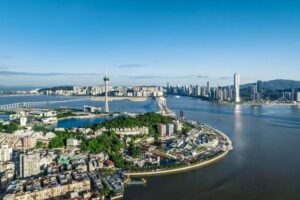
Macao possesses substantial fiscal buffers that provide it with the unique policy space to support this transition. The 2026 budget signals an expansionary stance, prioritising infrastructure, healthcare, and social benefits. However, the IMF notes that historical under-execution of spending could dampen this support. In order for the diversification agenda to succeed, the SAR must transition from a reactive fiscal posture to a proactive Medium-Term Fiscal Framework (MTFF) that aligns public investment with strategic goals like digital transformation and climate adaptation.
The cornerstone of the “new Macao” is the modernisation of its financial sector. This includes the development of a robust bond market and the integration of Fintech solutions, most notably the e-MOP (a retail central bank digital currency) currently in sandbox testing. These initiatives aim to deepen financial linkages with the Guangdong-Hong Kong-Macao Greater Bay Area (GBA) and provide a more sophisticated platform for international capital.
The establishment of the Guangdong-Macao In-Depth Cooperation Zone in Hengqin represents a spatial and logical extension of Macao’s economy, by leveraging
Hengqin’s land and logistical advantages, Macao-based firms are moving into high-value-added sectors, including modern finance, traditional Chinese medicine, and high technology. The recently approved Investment Fund Law further supports this by creating a framework for non-bank financial institutions (NBFIs) to flourish. For Africa, Macao’s transformation holds significant strategic relevance, particularly for the Lusophone (Portuguese-speaking) nations such as Angola, Mozambique, Cape Verde, and Guinea-Bissau. Macao has long served as a platform for cooperation between China and Portuguese-speaking countries.
Macao’s economic outlook is inextricably linked to global trends. While the recovery is robust, headwinds from geopolitical conflicts (such as the Middle East) and
potential trade tensions pose downside risks. Furthermore, the global shift toward stricter AML/CFT standards and the rise of digital finance are trends that Macao is navigating in real-time, positioning itself as a compliant and modern international
financial hub ahead of its 2028 Asia Pacific Group on Money Laundering (APG) Mutual Evaluation.
The SAR has set an ambitious target: increasing the share of non-gaming activities to 60 percent of GDP by 2030. Achieving this will require more than just capital; it will require a war for talent and the closing of digital infrastructure gaps. The
government’s MOP 20 billion Guidance Fund is intended to catalyse this shift, but success will depend on whether these investments are performance-based and targeted at sectors with genuine competitive advantages.
Though the path is fraught with demographic challenges and global uncertainties, its strong fiscal position and strategic integration with the Greater Bay Area provide a solid foundation.