
Egypt’s Earthquake Left no Casualties, but Exposed Urban Vulnerabilities
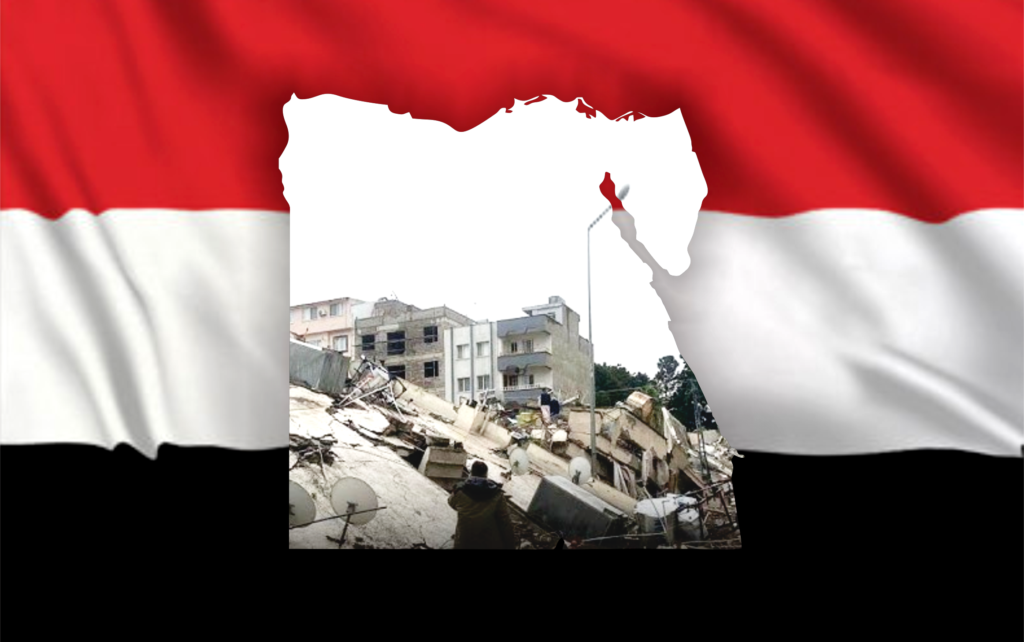
In Cairo, the magnitude 5.5 earthquake that jolted eastern Egypt in the early hours of Monday, August 3, has left the country facing a quieter but important aftermath. No reported deaths, no injuries and no major structural damage. Nonetheless, a reviewed public estimation of the vulnerable implication of densely populated cities, is exposed.
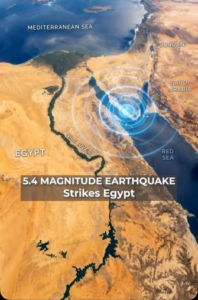
The shallow tremor, centered roughly 40 kilometres north of Suez at a depth of about 10 kilometres, struck at around 3 a.m. local time. Egypt’s National Research Institute of Astronomy and Geophysics revised the magnitude upward from an initial 5.2, while the U.S. Geological Survey placed it at 5.0.
The earthquake was felt across a wide area, including Cairo and Suez, extending toward El-Arish near the Gaza border and parts of southern and central Israel. As for various residents, the sudden shaking in the middle of the night, was less a disaster than a moment of acute uncertainty, as families were awakened, residents moved cautiously outdoors and communities turned to one another and official channels for reassurance.
The absence of casualties has been the defining fact of the event. But it should not obscure the broader human dimension of an earthquake in a country where large populations live in aging, densely packed or unevenly maintained buildings.
Egyptian authorities moved quickly to prepare for a potentially larger emergency. Health Minister Khaled Abdel Ghaffar activated the national health emergency plan, convened the central crisis operations room and placed critical-care units and ambulance services on heightened alert nationwide. The Egyptian Red Crescent also issued safety guidance, particularly urging residents to stay away from old, visibly cracked or structurally weakened buildings.
That response was significant precisely because the earthquake did not develop into a mass-casualty emergency. Emergency preparedness is often tested not by what happens, but by how quickly institutions can mobilise before uncertainty becomes catastrophe.
With no reported emergency calls or requests for assistance and no major damage recorded, authorities were able to shift rapidly from readiness to monitoring and reassurance. Yet, the absence of a disaster declaration, does not necessarily mean the absence of social consequences.
Earthquakes leave psychological effects that rarely appear in official casualty figures. For residents who experienced strong shaking while asleep, particularly families with children and people living in older buildings, the immediate concern can persist long after the ground stops moving: Is the building safe? Could another tremor come? Where should we go if it happens again?
That uncertainty places a premium on credible public information. The episode also highlights a more difficult enquiry for Egypt, on how prepared some communities are; not just simply for emergency institutions alone, but for a stronger earthquakes as this recent one.
A magnitude 5.5 tremor causing no significant damage is reassuring, but it also provides an opportunity to examine building safety, public awareness, evacuation planning and the ability of local authorities to identify vulnerable structures before a more destructive event occurs.
To the ordinary residents, restoration after an earthquake is not limited to repairing broken infrastructure. It includes restoring confidence. That requires transparent inspections where buildings are suspected of being unsafe, accessible information for residents and sustained cooperation between national agencies, municipalities, medical services, civil-society organisations and neighbourhood communities.
The Egyptian Red Crescent’s public warnings illustrate the importance of grassroots communication. In an emergency, residents are often the first people able to help neighbours, check on vulnerable family members and share reliable information. Building that community capacity before an earthquake may ultimately save more lives than relying exclusively on emergency intervention afterward.
Diplomatically, the earthquake also underscored the interconnected nature of seismic events across borders. Tremors felt from Egypt into neighbouring parts of Israel and the wider region are a reminder that disaster preparedness is not solely a domestic concern. Reliable scientific information, cross-border communication and coordinated emergency knowledge can reduce fear and prevent misinformation when natural hazards strike.
In the meantime, Egypt’s earthquake story is one of preparedness rather than destruction. No lives were lost, no injuries were reported and no major property damage emerged. But the real measure of the aftermath will be whether the calm that followed the tremor becomes an opportunity to strengthen buildings, communities and institutions before the next earthquake arrives.