

Nigeria’s Vice President Outlines National Grand-Strategy to Boost Food Security at the Davos Summit

In Davos, Switzerland, Nigeria is reshaping the way it approaches food security, moving beyond a narrow agricultural focus to treat it as a cornerstone of national stability, economic resilience, and regional cooperation. Vice President Kashim Shettima unveiled the country’s ambitious macro-strategy during a high-level panel titled “When Food Becomes Security” at the World Economic Forum (WEF) in Davos on Thursday.
“In Nigeria, we don’t see food security simply as an agricultural challenge. It is a macroeconomic, governance, and security issue”, Shettima said, framing the government’s approach as both preventive and transformative. “Our goal is to make food security a pillar for national stability, regional cohesion, and sustainable development”. A multi-dimensional approach for the food-security of citizens.
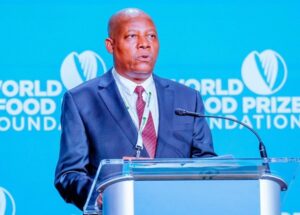



The Vice President described a strategy built on three central pillars: boosting food production, promoting environmental sustainability, and deepening regional integration within West Africa. According to Shettima, Nigeria’s recent experience with global supply chain disruptions, climate shocks, and conflict-driven displacement has underscored the urgent need for resilient food systems tailored to its diverse ecological zones. He explained that “Nigeria is a vast country with intertwined economic and ecological realities. In the Sahelian North, desertification and drought threaten livelihoods, while flooding is increasingly frequent in the South and parts of the North Central regions.”
To confront these challenges, the government is prioritizing climate-smart agriculture. Early-maturing, drought-resistant and flood-tolerant crops such as rice, sorghum and millet are being scaled, alongside redesigned food systems in flood-prone areas. Driving security and community engagement.


Conflict and insecurity remain major obstacles to agricultural productivity, particularly in key food-producing regions. To address this, Nigeria is creating food security corridors, safe zones that enable farmers to resume cultivation and strengthening community-based security initiatives. The Back to the Farm Initiative provides displaced farmers with seeds, fertilizer, insurance and access to capital, encouraging a return to productive lands. “These interventions are not just about crops, but restoring livelihoods, social stability, and hope to communities long disrupted by insecurity”, Shettima said.
In view of the economic implications and policy innovation, the Nigeria’s strategy also confronts structural economic vulnerabilities. Heavy dependence on imports of wheat, sugar, and dairy has fueled food inflation and exposed the country to foreign exchange volatility. Shettima emphasized local alternatives, promoting sorghum, millet, and cassava flour to reduce import reliance while stabilizing prices. “The intersection of food security and macroeconomic policy is critical. By supporting local production, we are not only ensuring access to food but also controlling inflation and fostering economic resilience”, he said


In respect to the regional and continental dimensions, Shettima called on African nations to enhance cooperation under the African Continental Free Trade Area (AfCFTA), noting that intra-African trade is no longer optional in a rapidly realigning global economy. “We need cross-border solutions that strengthen food systems, stabilize economies, and secure livelihoods across the continent”, he said.
He expressed optimism that reforms under President Bola Tinubu’s Renewed Hope Agenda would translate into scalable investments for smallholder farmers and fishermen, improved climate adaptation, and a surge in intra-African trade, which are measures bagged with the potential to empower local communities, reduce rural poverty and strengthen regional integration.

Furthermore than economic and security considerations, Shettima highlighted the human dimension of food security. Strengthened agricultural systems, he noted, directly support women farmers, youth entrepreneurs, and vulnerable communities, offering pathways out of poverty while reducing social tensions in conflict-prone areas.
Shettima proclaim that this is a strategy for people, communities and the nation. That Food security is not a sector, but a lifeline for development, peace, sustainable prosperity and sociocultural security.