
Saudi Arabia’s ‘White Gold’-(White Strawberries) Emerge as a Soft-Power Symbol of Prince Mohammed bin Salman’s Vision 2030
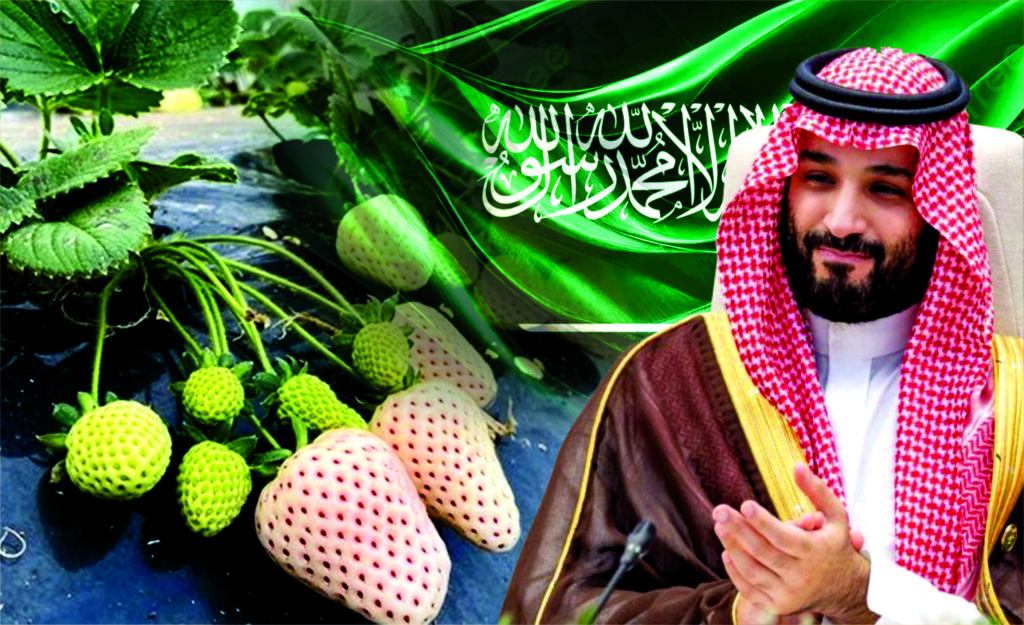
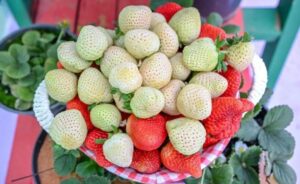
What looks like a simple family pastime is quietly becoming a marker of economic change across the Middle East. Strawberry picking, which is a long-weekend ritual in Israel and familiar in parts of the Arab world, has taken on new meaning this season in Saudi Arabia, where farmers in the northern Hail region have unveiled the kingdom’s first locally grown white strawberries.
Nicknamed “red gold” in Arabic because of their high market value, strawberries are now arriving in a new shade. Saudi media have framed the debut of white strawberries as more than a novelty crop: it is being presented as evidence of a fast-modernizing agricultural sector aligned with Crown Prince Mohammed bin Salman’s Vision 2030 agenda, which aims to diversify the economy beyond oil and strengthen domestic production.
According to Al Arabiya, the introduction of white strawberries reflects the sector’s ability to absorb innovation and advanced farming techniques, while improving sustainability and efficiency. Behind the headlines, the project also highlights how Saudi agriculture is increasingly shaped by international partnerships. Farm owners in Hail say production was made possible through cooperation with the University of Florida, underscoring how global research networks are being woven into local food systems.
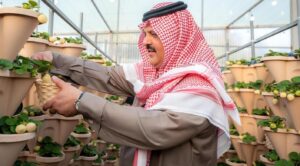
To the Saudi government officials, the symbolism is clear. Fahad Al-Hasani, director general of the Ministry of Environment, Water and Agriculture’s Hail branch, described the white strawberry as proof of the “advanced level” of Saudi farming and its contribution to Vision 2030 goals of raising productivity, diversifying income streams and promoting high-quality national produce. The emir of Hail, Abdulaziz bin Saad bin Abdulaziz, echoed that message during a visit to inaugurate the crop earlier this month, praising state support for agriculture and positioning the region as a national leader.
However, on the ground the story is also about people and place. Hail has already established itself as a hub for strawberry cultivation, with farms designed as family destinations rather than industrial sites. Visitors can pick strawberries grown using hydroponic systems, relax in shaded seating areas, buy coffee and local products, and let children play among the rows. Art stalls and social media promotion such as the popular TikTok account “Hail Strawberry Farms”, have turned agriculture into a lifestyle experience, blurring the line between farming, tourism and community life.
White strawberries are not unique to Saudi Arabia; they are already grown in several countries, including Israel. Their arrival in Hail nonetheless carries diplomatic undertones, reflecting a broader regional convergence around high-tech agriculture, water-efficient growing methods and agri-tourism. Across borders, similar scenes are unfolding.
In Egypt, the strawberry harvest near Ismailia has been widely covered this month as both an economic and tourism event. While white strawberries are not cultivated there, local media credit cooperation between government bodies, youth initiatives and private investors for turning the season into a source of jobs and export revenue. Officials describe Ismailia as a “quality brand” trusted by international markets. It is a reminder that strawberries can anchor local development strategies as much as national ones.
In Jordan, farms along the Amman–Madaba road invite families to “pick it yourself” rather than buy from markets. One such farm markets its produce as grown “with a European touch, on Jordanian soil,” a nod to hydroponic methods similar to those used in Saudi Arabia and Israel. At five dinars per kilogram, the experience is priced not just as food, but as leisure.
Taken together, these scenes point to a quieter transformation. From Hail to Ismailia to Madaba, strawberries are becoming tools of grassroots engagement, rural employment and soft diplomacy.
In Saudi Arabia, the white strawberry may be framed as a Vision 2030 success story, but its real power lies in how it connects policy goals to everyday life, turning a family’s day out into a symbol of economic ambition, technological exchange and regional convergence.