

Giant Carboniferous Sharks Entombed by Time, Resurfaces from America’s Caves
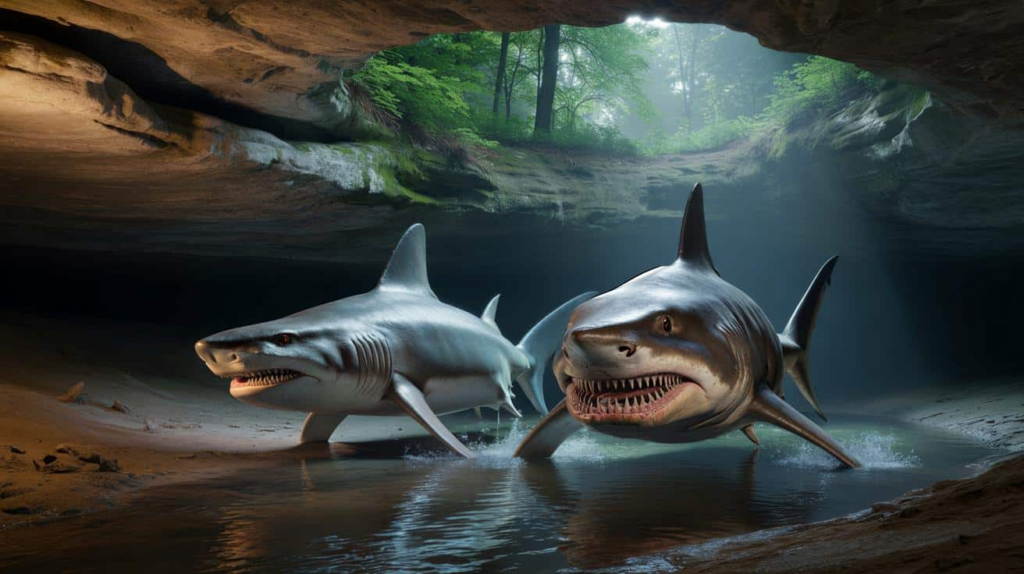
Far beneath the forests of Kentucky and Alabama, far from any modern shoreline, two giant sharks have been waiting, sealed in stone for roughly 325 million years. Their recent emergence from limestone caves has given scientists a rare and intimate look at a time when vast inland seas covered North America and sharks ruled long before dinosaurs appeared.
The fossils discovered in the Mammoth Cave system in Kentucky and a remote cavern in Alabama, are extraordinary not just for their size, but for their completeness. While most ancient shark finds amount to little more than scattered teeth, these specimens preserve much of the animals’ anatomy, offering a near-life portrait of Carboniferous marine predators. “It’s like the caves pressed pause on decay”, one researcher noted.
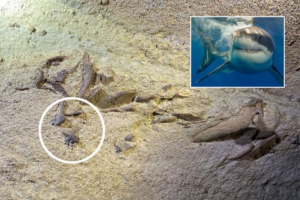
Constant darkness, stable temperatures around 13°C and humidity nearing saturation created a natural vault. Shielded from sunlight, scavengers and chemical weathering, the sharks fossilized slowly and delicately, in some cases retaining impressions of skin, fin spines and even mineralized internal structures, an almost unheard-of outcome for cartilage-based skeletons.
The story of how ocean predators ended up underground begins with retreating seas. During the Carboniferous period, warm, shallow waters flooded much of what is now the American Midwest and Southeast. When those seas withdrew, marine life was stranded. Fine limestone sediments quickly buried the remains and over millions of years, dissolving rock carved the cave systems that would eventually reveal them again.
The two sharks represent different approaches to survival in those ancient waters. Troglocladodus trimblei, measuring about three meters, was a sleek and agile hunter. Its bifurcated, razor-sharp teeth were ideal for gripping slippery prey, while prominent dorsal spines added stability and defense as it patrolled reef edges and coastal shallows. Its larger counterpart, Glikmanius careforum, stretched up to 3.6 meters and embodied brute strength. With massive jaws and robust teeth, it likely sat near the top of the food web. Comb-like dorsal spines, part weapon, part stabilizer, shows a predator built for dominance in crowded, competitive seas.
Together, the sharks paint a picture of a vibrant and complex ecosystem. Carboniferous coastlines were dense with early bony fish, smaller sharks, shellfish and armored amphibians. Underwater forests and reefs supported rich biodiversity, and these giants were central players, shaping food webs that would influence shark evolution for hundreds of millions of years.
Apart from their scientific value, the discoveries connect human curiosity with deep time. They emphasize how by chance geology and patient exploration can rewrite what we know about life’s past. Hidden beneath familiar landscapes, an entire world’s remain preserved, awaits light.
With regards to paleontology, the message is clear that the planet still holds remarkable secrets. And sometimes, the clearest windows into vanished oceans are found not at sea, but in the quiet darkness areas underneath our feet.