

Scientists Discover Sunken Lost-World Beneath North-Sea, Challenging Human History

A vast, now-submerged landscape beneath the North Sea is reshaping how scientists understand early human life in Europe. Known as Doggerland, this prehistoric region once connected Great Britain to mainland Europe; and according to new research, it was far from a barren land bridge.
Instead, emerging evidence suggests Doggerland was a thriving ecological and human hub, rich with forests, wildlife, and resources long before it disappeared beneath rising seas.
In a recent study led by University of Warwick, scientists analyzed sedimentary ancient DNA (sedaDNA) from dozens of marine cores drilled across the southern reaches of Doggerland. Their findings, published in Proceedings of the National Academy of Sciences, reveal that temperate woodlands, including oak, elm, and hazel, were already established more than 16,000 years ago. This pushes back the timeline for forest growth in the region by thousands of years, challenging long-held assumptions about post-Ice Age recovery after the Last Glacial Maximum.
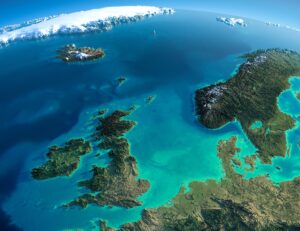

The discovery of DNA from Pterocarya, a tree thought to have vanished from northwestern Europe hundreds of thousands of years earlier, adds another layer of intrigue, suggesting hidden ecological refuges may have preserved species through extreme climate shifts. Doggerland was largely framed as a migration corridor for decades. It is a temporary crossing point for early humans moving into Britain. But this new research supports a more complex picture.
The region’s dense woodlands and abundant fauna, including beavers, deer, boar and bears, would have provided fertile ground for sustained human habitation. Researchers now argue that Doggerland may have supported multiple early Mesolithic communities, rather than simply serving as a passageway.
This reinterpretation carries cultural weight. If Doggerland was indeed a long-term settlement zone, it may explain why early human evidence in Britain appears relatively sparse: populations may have thrived in areas that now lie underwater, beyond the reach of traditional archaeology.
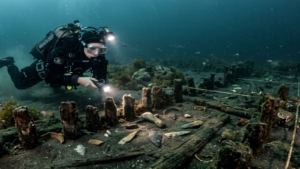
Doggerland’s eventual fate, which gradually submerged as sea levels rose, resonates strongly in today’s climate discourse. The landmass is believed to have persisted until around 7000 years ago, surviving multiple flooding episodes, including the catastrophic Storegga tsunami. To the modern coastal societies, the parallels are hard to ignore. What happened to Doggerland underscores how environmental change can redraw maps, erase communities, and reshape economies over time.
The renewed focus on Doggerland is also influencing contemporary industries. Offshore energy development, particularly wind farms in the North Sea, increasingly intersects with submerged archaeological zones. This raises questions about how to balance infrastructure expansion with heritage preservation.

Meanwhile, advances in sedaDNA technology are opening new frontiers for research, enabling scientists to reconstruct entire ecosystems from microscopic traces. The implications extend beyond Europe, offering tools to explore other submerged or inaccessible landscapes worldwide. Researchers believe that Doggerland represents more than a geological curiosity. They see it as a missing chapter in the story of human adaptation, migration and resilience.
What emerges from the seabed is an evidence of ancient trees, vanished animals and a portrait of a dynamic landscape, where humans once lived, hunted and built communities, before the waters rose and history slipped beneath the waves.