
IMF Rates-Down Global Growth Forecast as Middle East Conflict Drives Energy Shock and Economic Uncertainty
The International Monetary Fund has trimmed its global growth forecast for 2026 to 3.1%, down from 3.3% projected just three months ago. It is a modest-outlook revision that masks profound anxieties about a world economy that is increasingly a hostage to geopolitical shocks.
At the center of the downgrade is the escalating conflict in the Middle East, which has disrupted energy flows, rattled financial markets, and revived inflationary pressures just as many economies were beginning to stabilize. In blunt terms: without the war, the IMF suggests global growth could have been upgraded to 3.4%, buoyed by resilient demand and continued investment in technology. Instead, the global economy is once again navigating uncertainty rather than recovery.
The IMF’s “reference scenario” assumes the conflict remains contained and begins to ease by mid-2026, allowing growth to hold at 3.1%. But the institution’s alternative projections paint a far more troubling picture. In an adverse scenario, where oil prices hover around $100 per barrel due to prolonged instability, global growth could slip to 2.5%. A more severe outcome, involving sustained damage to critical energy infrastructure, could push growth down to 2%. That level, economists warn, edges dangerously close to a global recession threshold.
This range of outcomes stresses a central reality that the global economy is no longer driven solely by business cycles or policy decisions, but by geopolitical breaking-point that can abruptly rewrite economic trajectories; and the shock in energy sector in this respect, reignites inflation fears across the globe. The most immediate transmission channel of the conflict is energy. Disruptions linked to the strategic Strait of Hormuz, through which roughly a fifth of global oil supply passes, have triggered what economists describe as a classic negative supply shock.
The result is already visible in inflation forecasts. Global headline inflation is now expected to rise to 4.4% in 2026, reversing what had been a gradual cooling trend. To most households, this translates into higher fuel and food costs, while for businesses across board, rising input prices and squeezed margins, become the featured actors. Regarding central banks, the timing is particularly awkward. Many had been preparing to ease monetary policy after years of aggressive rate hikes. Now, they face a renewed dilemma of support growth or contain inflation. The IMF’s advice to stay vigilant, mirrors how little room policymakers have to maneuver.
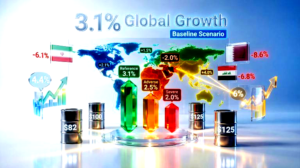
While the economic slowdown is global, its effects are far from evenly distributed. The Middle East and North Africa region are expected to bear the brunt, with growth forecasts slashed to just 1.1%, which is a steep 2.8 percentage point drop. But the ripple effects extend well beyond the region. Energy-importing economies, particularly in parts of Africa and Asia, face worsening trade balances and currency pressures. As for countries like Nigeria, higher oil prices may boost government revenues, but the benefits are often offset by domestic inflation and structural inefficiencies that limit broad-based gains.
In advanced economies, the impact is subtler but still significant, showcasing weaker consumer confidence, volatile financial markets and delayed investment decisions. Putting markets on the edge, with policy choices narrowing-down.
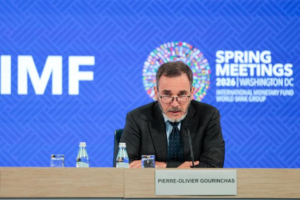
Financial markets are already reacting to heightened uncertainty. The IMF warns of tighter financial conditions, lower asset valuations and rising risk premiums. In practical terms, borrowing costs could climb for governments and businesses alike, complicating efforts to sustain growth. This dynamic raises broader political questions. Governments facing higher debt burdens and restive populations, will need to balance fiscal support with long-term sustainability. The IMF’s call for “targeted, timely and temporary” measures is as much a political directive as an economic one, a warning against broad, populist spending that could worsen fiscal fragility.
The IMF’s latest outlook highlights a sobering modification that global growth is no longer driven primarily by innovation, trade, or productivity gains, but increasingly shaped by disruptions like pandemics, wars and supply-shocks. Even at 3.1%, growth remains below pre-pandemic norms. The downgrade may be only 0.2 percentage points on paper, but it indicates an intense vulnerability. The global economy is expanding, but without momentum and with little strength to absorb further shocks.
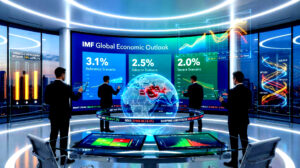
In this sense, the real story is not the reduction of the global growth forecast for 2026 itself, but what it represents connotation – a world economy stuck in a cycle of recovery but interrupted; where stability is provisional and risks are persistently skewed to the downside.