
Cameroon Pushes to Localize Defence Production in Bid for Industrial Sovereignty

The government of Cameroon has formalised a series of defence-industrial partnerships with domestic private sector firms, showing a calibrated shift toward local production, reduced import dependence and greater strategic autonomy. The three agreements, signed in Yaoundé on April 8 under the supervision of Defence Minister Delegate Joseph Beti Assomo, cover the manufacturing of armoured vehicles, ballistic protection equipment and mechanical spare parts.
The agreements reflect a broader policy realignment, embedded in the government’s long-term development blueprint, the National Development Strategy 2030, away from their technical scope. At their core is an import-substitution strategy aimed at retaining value within the domestic economy while strengthening national control over critical security infrastructure.
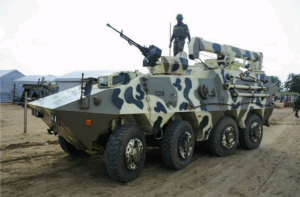
The first agreement tasks Sotrabus, a domestic automotive firm, with converting new Toyota Land Cruiser units into armoured combat vehicles equipped with integrated fighting systems. Production will be based in Douala, the country’s commercial hub, with delivery scheduled across four phases over an 11-month period. The vehicles are intended to enhance troop mobility across multiple operational theatres, particularly in regions facing asymmetric security threats.
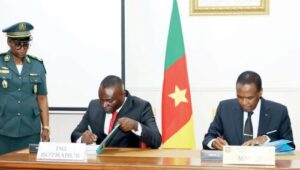
A second agreement provides for the construction of a ballistic protection manufacturing facility, with a projected completion timeline of 24 months. Once operational, the plant is expected to produce up to 25,000 bullet-proof vests annually from its third year. A third project, also scheduled over two years, will establish a factory dedicated to the production of mechanical spare parts for military vehicles—an intervention aimed at reducing maintenance delays and improving operational readiness through localised supply chains.
Economically, the initiative positions defence procurement as a lever for industrialisation. By prioritising domestic firms over suppliers from Europe and Asia, the government is attempting to deepen local value chains, stimulate manufacturing activity and curb foreign exchange outflows linked to defence imports. This aligns with a broader trend across African economies seeking to internalise production in strategic sectors amid global supply chain disruptions.
The projects are also expected to generate skilled employment and catalyse technology transfer. Each agreement includes provisions for capacity-building within the Ministry of Defence, suggesting a deliberate effort to bridge gaps in technical expertise while fostering a domestic industrial workforce. Over time, such measures could contribute to the emergence of a specialised defence manufacturing ecosystem with spillover benefits for adjacent sectors such as engineering, metallurgy and logistics.
However, the success of this strategy will depend on execution capacity, sustained financing and the ability of local firms to meet quality and scale requirements typically associated with defence production. Without these, import substitution risks raising costs or compromising standards.
At the sociocultural level, the localisation drive may carry symbolic weight, reinforcing narratives of national self-reliance and technological progress. In a context where dependence on foreign suppliers has historically shaped perceptions of state capacity, visible domestic production of military equipment can function as a marker of sovereignty and institutional competence.
At the same time, the expansion of a defence industrial base raises questions about civil-military relations and public priorities. In a country where social spending needs remain significant, increased investment in defence manufacturing could prompt debate over resource allocation, particularly if the economic dividends such as in jobs creation, skills acquisition and industrial growth, are unevenly distributed.
Politically, the agreements underscore a growing emphasis on strategic autonomy in response to evolving security challenges and geopolitical uncertainty. Cameroon continues to face security pressures in multiple regions, including insurgency threats and cross-border instability. In this context, reliance on external suppliers, which is often a subject to geopolitical constraints, export controls or delays, poses operational risks.
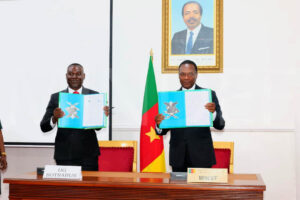
By cultivating domestic production capacity, the government is seeking to insulate its defence apparatus from such vulnerabilities. The decision to favour national firms over competing international offers also reflects a form of economic nationalism in strategic sectors, reinforcing state control while potentially reshaping relationships with traditional defence partners. The initiative builds on earlier investments, including the 2025 inauguration of a military clothing production facility in Ekounou and ongoing work on a footwear manufacturing plant. Taken together, these projects point to the gradual construction of an integrated defence industrial base.
Whether this emerging ecosystem can achieve scale, competitiveness and sustainability remains uncertain. Nonetheless, the direction of the policy is clear, which is, Cameroon is positioning defence production as a security imperative and a cornerstone of its industrial/economic transformation agenda.