

Celebrating Black Women Who Are Reshaping Global Military Leadership, Breaking Ranks and Building Futures
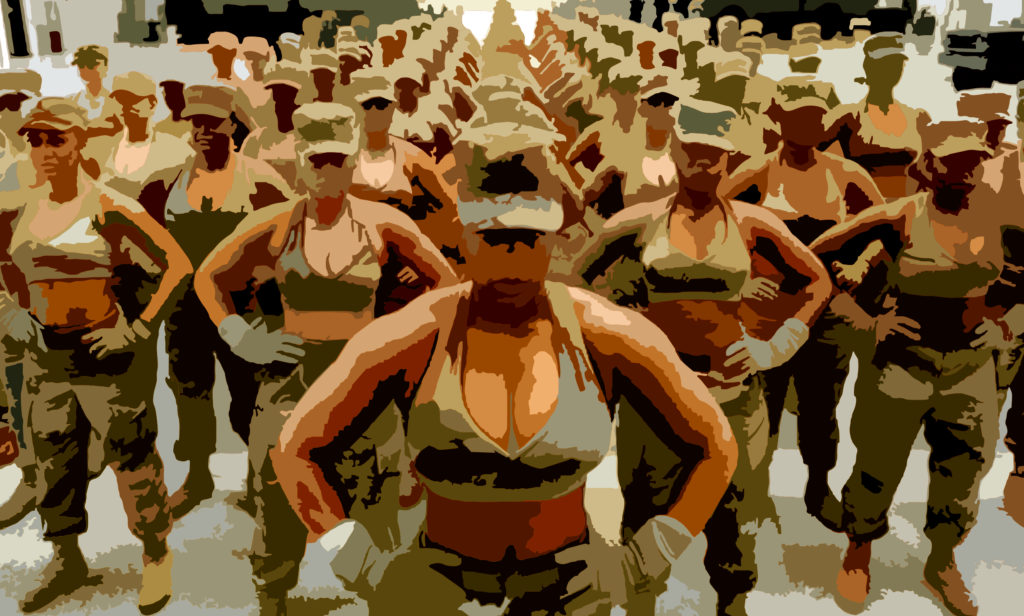
Black women are increasingly breaking barriers in global military leadership, particularly within the United States Armed Forces, where they are attaining general officer ranks, commanding major installations and leading critical combat-support and cyber units. Long underrepresented in senior command, they are now emerging as trailblazers across both officer and top enlisted roles.
Among the notable leaders is Brig. Gen. Amanda Azubuike, a Nigerian-American with more than three decades of service across aviation, intelligence and public affairs, who made history as a US Army brigadier general. In the US Marine Corps, Maj. Gen. Lorna Mahlock became the first Black woman to achieve two-star rank, now commanding the Cyber National Mission Force. The Army has also marked milestones with Maj. Gen. Marcia Anderson, its first Black female two-star general, and Maj. Gen. Janeen Birckhead, who serves as Maryland’s Adjutant General, overseeing the state’s military forces. At the installation level, Col. Lakesha Stokes broke new ground as the first Black woman to serve as garrison commander at Fort Cavazos.
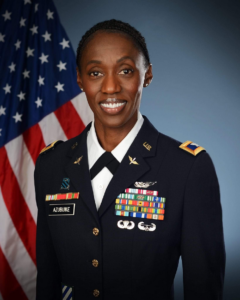 Brig. Gen. Amanda Azubuike
Their rise builds on a longer legacy. Charity Adams Earley, the highest-ranking Black woman officer during World War II, commanded the all-Black, all-female 6888th Central Postal Directory Battalion, renowned for efficiently clearing massive mail backlogs for US troops in Europe.
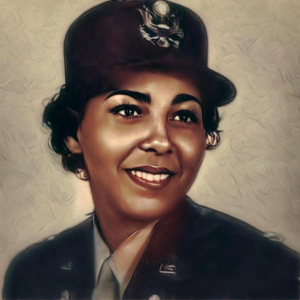 Charity Adams Earley
Althrough many generations, the upper echelons of military power for the corporate boardrooms and government cabinets, have reflected narrow definitions of who gets to lead. Today, those boundaries are shifting. Across continents, Black women are rising to senior leadership in institutions long dominated by men, challenging assumptions about authority, nationality and gender. Few stories capture this transformation as vividly as that of Brigadier General Amanda Azubuike, the first Nigerian woman to attain that rank in the United States Army, amongst other female officers.
Azubuike’s promotion is more than a personal milestone. It is a signal moment in a broader global reckoning with representation and opportunity that resonates from military academies to grassroots women’s networks across Africa and the diaspora. It is a journey across borders.
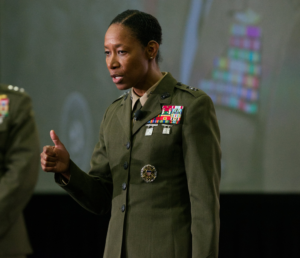 Maj. Gen. Lorna Mahlock
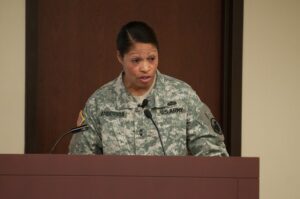 Maj. Gen. Marcia Anderson
Born to Nigerian parents and raised between Nigeria and Zimbabwe, Amanda Azubuike’s path to the U.S. Army was neither linear nor easy. Her career spans aviation, strategic communications and senior advisory roles. Fields that demand technical expertise, public trust and political sensitivity. Over time, she moved from operational roles to the strategic center of military decision-making, advising top commanders and shaping how the Army communicates at home and abroad.
Her rise to brigadier general places her among a small, influential group of officers responsible not only for battlefield readiness but also for diplomacy, civil-military relations, and institutional reform. In an era when armed forces are under scrutiny for how they reflect the societies they serve, Azubuike’s leadership carries symbolic and practical weight.
To many African and Black women watching from afar, her story disrupts a persistent narrative that global power structures are closed to those without the right background, passport, or identity.
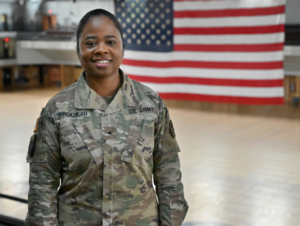 Maj. Gen. Janeen Birckhead
Standing on the shoulders of pioneers, Azubuike’s achievement did not emerge in a vacuum. Decades earlier, Hazel Johnson-Brown broke another historic barrier, becoming the first Black woman general in the US Army and the first Black Chief of the Army Nurse Corps. Johnson-Brown transformed military nursing into a globally respected profession, emphasizing education, ethical leadership, and service beyond borders.
Her legacy reframed what leadership could look like in uniform: collaborative rather than purely hierarchical, grounded in care as well as command. Together, figures like Johnson-Brown and Azubuike illustrate how progress often unfolds as a single breakthrough, and as a relay across generations.
Military institutions wield enormous influence, shaping national security policy, humanitarian responses, and international alliances. When leadership lacks diversity, blind spots follow. Analysts and advocates argue that inclusive leadership improves decision-making, strengthens legitimacy, and enhances trust between armed forces and civilian populations.
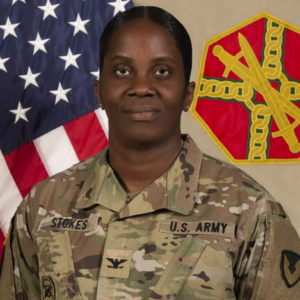 Col. Lakesha Stokes
Azubuike’s background in aviation and public affairs is particularly significant. Modern militaries rely as much on communication and perception as on hardware. Strategic messaging, crisis response, and engagement with local communities are now central to defense policy. Having leaders who understand multiple cultures and identities is not symbolic, but operationally relevant.
From a global perspective, her promotion also challenges lingering postcolonial assumptions. That a woman of African heritage can rise to senior rank in one of the world’s most powerful militaries underscores how excellence transcends nationality and race, even as institutions continue to grapple with inequality.
Cycloning grassroots inspiration towards global echoes. Farther than policy circles, the impact is deeply personal. Across Africa, the Caribbean, Europe and North America, women in uniform and those considering military or security careers, cite visibility as a turning point. Seeing leaders who look like them makes ambition feel attainable.
Grassroots organizations focused on girls’ education, STEM training and leadership development increasingly point to figures like Azubuike as proof that barriers can be broken. Social media has amplified this effect, turning individual promotions into collective moments of pride and motivation.
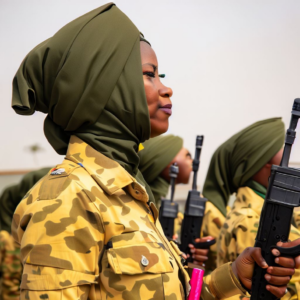
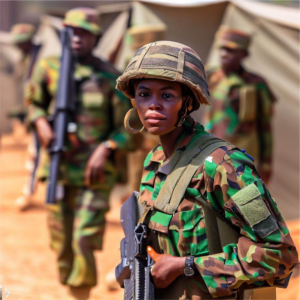
Yet, inspiration alone is not enough. Many women still face systemic obstacles: limited access to mentorship, biased promotion systems, and workplace cultures resistant to change. In some countries, legal and social norms continue to restrict women’s participation in defense and security roles altogether.
Globally, armed forces are under pressure to reform, driven by changing warfare, demographic realities, and public accountability. Some militaries have introduced gender integration policies, leadership quotas, and family-support programs. Others lag behind, treating diversity as a public relations issue rather than a strategic necessity.
Experts caution that celebrating “firsts” must be paired with sustained institutional change. True inclusion means women are not exceptions, but integral to decision-making at every level. It also means addressing intersecting challenges faced by Black women, who often navigate both gender and racial bias.
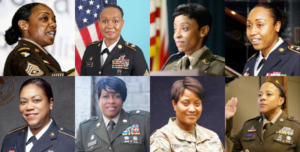
Today, Black women continue to shape the force. African American women enlist at higher rates than their white or Hispanic counterparts, accounting for roughly one-third of all women in the US military. They also hold significant influence in senior enlisted leadership, comprising nearly half of female sergeants major in the US Army. While progress has been substantial, many still navigate persistent challenges linked to race, gender and entrenched stereotypes.
Since the 2013 lifting of restrictions on women in combat roles, Black women have expanded their presence in operational and combat-related positions, reinforcing their growing impact on military leadership. Their advancement reflects both institutional change and decades of perseverance in the fight for recognition, opportunity and command.
In respect to Azubuike and others like her, leadership now carries an added burden, representing progress while pushing for more of it. Their presence opens doors, but keeping them open requires policy, persistence, and political will.
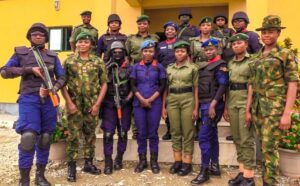
The rise of Black women in military, corporate, and government leadership reflects a wider global transformation. From boardrooms to battlefields, traditional hierarchies are being questioned by a new generation that sees diversity as strength, not threat.
Brigadier General Amanda Azubuike’s story is one about migration, resilience and diligence in service. Nevertheless, it is also cultural and political, highlighting how institutions evolve when challenged by talent that refuses to be sidelined.
As more women follow in her footsteps, the question is no longer whether Black women belong in the highest ranks of leadership. It is how quickly and seriously systems will adapt to the reality that they are already there.