
China’s Ambitious Undersea Rail Projects Breath New Connectivity: a Consequence of Bold Engineering
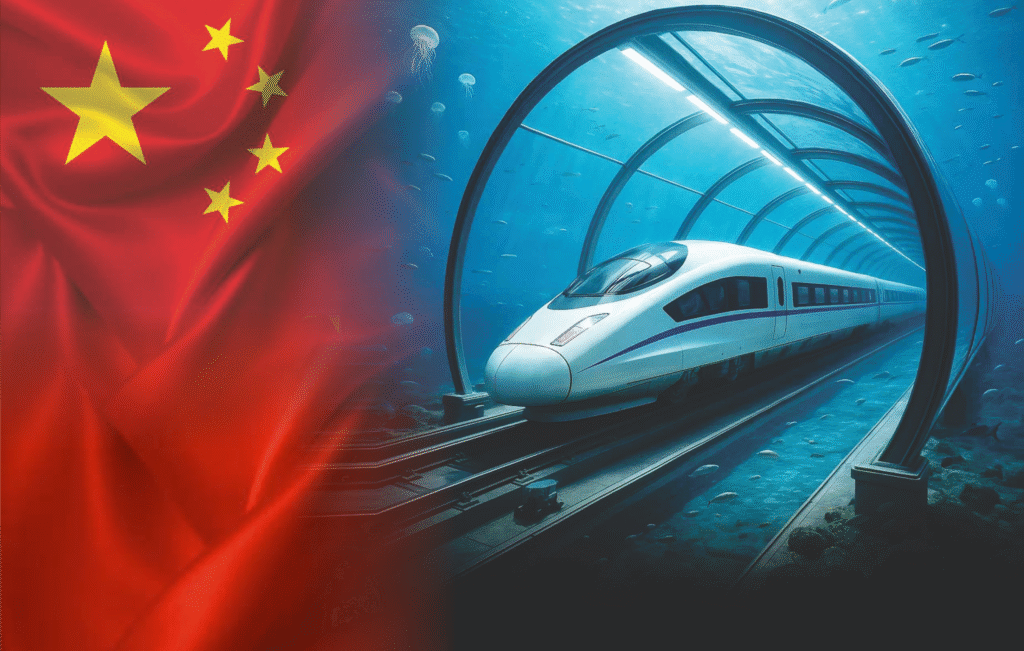
China is preparing for two major undersea rail projects that could reshape mobility, commerce and daily life along its eastern seaboard. One is still on the horizon, the vast Bohai Strait Tunnel, while the other, the Ningbo–Zhoushan high-speed railway tunnel, is already taking shape beneath the sea. Together, they illustrate how the country blends long-term ambition with near-term infrastructure demands, and how the effects of such mega-projects ripple far beyond transport alone.
The proposed Bohai Strait Tunnel would span roughly 123 kilometres, more than 120 of them underwater, linking the Liaodong Peninsula with Shandong. If completed, it would be the world’s longest undersea high-speed rail tunnel, slashing travel time between Dalian and Yantai from over six hours to about 40 minutes.
Approved but not yet under construction, the project remains a symbol of China’s future-leaning infrastructure strategy. An enormous engineering challenge matched by equally large political and economic motivations.
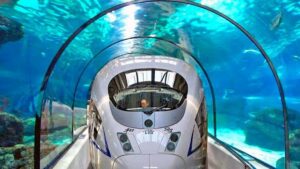
Meanwhile, the Ningbo-Zhoushan high-speed railway tunnel, featuring a 16.18-kilometre undersea section, is progressing steadily. Once in service, the line will cut journeys between the two cities to less than 30 minutes, bolstering connectivity for a region dependent on maritime trade and tourism.
While smaller in scale, the project is more immediate, offering a preview of how communities adapt when islands and coastal cities are effectively pulled closer together.

Further than the engineering breakthroughs, these tunnels carry significant implications for everyday life, such as: shorter shuttles could redraw family routines, allowing workers to live farther from major hubs without wasting time. Migratory patterns may shift, as improved access encourages families to relocate for better schools, jobs or cost-effective housing. Generational dynamics could change too, encouraging the youth to be more willing to stay near home because of transport network that may bring-in new industrial developments into previously isolated areas. These are subtle but meaningful shifts that emphasizes how transportation infrastructure ultimately reshapes sentiments and geography of a country.
Even though both tunnels lie entirely within China, they connect regions with distinct local identities, dialects and traditions. Faster travel can strengthen cultural exchange, boosting domestic tourism and exposing communities to each other’s food, festivals and ways of life. On the other hand, rapid integration often raises concerns about cultural dilution, especially for smaller island communities like Zhoushan that fear being overshadowed by larger mainland economies. Infrastructural ties often become cultural ties, whether welcomed or resisted.
The economic and business consequences. As for industry, the gains could be decisive: The Bohai transport crisscrossing promises to relieve a major bottleneck in China’s north-south logistics corridor, speeding supply chains from inland factories to ports. Businesses may see lower transportation costs, faster delivery cycles and greater flexibility in where to place warehouses and manufacturing sites. The Ningbo-Zhoushan link could strengthen the Zhoushan archipelago’s role as a port and shipbuilding center, drawing investment and workers to the region.
The administrative and strategic calculations make these tunnel projects to also reflect China’s broader political goals:
- They signal confidence in national engineering capacity, reinforcing the country’s reputation for large-scale infrastructure achievement.
- Enhanced mobility strengthens domestic cohesion, linking far-flung communities more tightly to political and economic centers.
- Projects of this scale also serve as long-term strategic investments, reshaping trade corridors and demonstrating Beijing’s capability for multi-decade planning.
While it is not geopolitical in the sense of linking continents, the projects do show how domestic infrastructure supports China’s wider global ambitions.
As noted with all transformative projects, there are challenges that accompany infrastructural development and their progress. Some of which in this case comprise: environmental impacts from the seabed disruption to marine ecosystem stress, are still being debated. Urban development pressures may increase as regions along the routes attract new construction and rising property prices. And for communities accustomed to relative isolation, the sudden arrival of new visitors and businesses can trigger social adjustment and concerns about change. How these issues are managed may determine whether the benefits of the tunnels are felt evenly across society.
China’s undersea rail ambitions, speculatively spanning the Bohai Strait tunnel and the very real Ningbo-Zhoushan project, reveal a country preparing for a more tightly connected future. While the engineering headers are compelling, the profound story lies in how such links will impact families, cultures, economies and national identity.
These tunnels would not bridge continents, but they would bridge sociocultural existence, and in the process, reshape China’s socioeconomic seascape for decades to come.