

EU Launches Invest4Libya to Reform Public Finance and Unlock Digital, Green Growth
TRIPOLI – The European Union has launched Invest4Libya, a wide-ranging economic reform and investment support programme aimed at strengthening Libya’s public finances, modernising its financial sector and translating policy reform into real gains for citizens, entrepreneurs and small businesses.
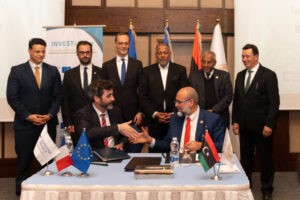
Officially inaugurated by Libya’s Ministry of Finance alongside the EU Delegation to Libya, the French Embassy and implementing partner – Expertise France, the project emanates at a critical moment for a country seeking economic stability after years of political fragmentation, weak fiscal oversight and limited private-sector confidence.
In essence, Invest4Libya is designed to tackle a long-standing paradox in Libya, a state with rich-resource, fragile institutions, high youth unemployment and an underdeveloped non-oil economy. By focusing simultaneously on public financial management, financial sector governance, and entrepreneurship, the initiative aims to close the gap between government reform and everyday economic opportunity. “Improving transparency and efficiency in public finance is not a technical exercise; it directly affects citizens to trust in the state and the services they receive”, said Finance Minister Dr. Khaled Almbarouk, describing the project as aligned with Libya’s national reform priorities.
Investigative assessments by international partners have repeatedly highlighted weak budget controls and fragmented oversight as barriers to development in Libya. Under its first pillar, Invest4Libya will support the Ministry of Finance and the Audit Bureau to strengthen fiscal transparency, improve spending efficiency and reinforce accountability. These are steps seen as essential to reducing waste and restoring credibility in state institutions.
The second pillar targets financial sector governance. An area where regulatory gaps have limited access to finance, particularly for young entrepreneurs and women-led businesses. Working with the Central Bank of Libya and the Ministry of Planning, the project seeks to modernise regulatory frameworks and integrate digital and green finance into national policy, expanding financial inclusion while aligning Libya with global investment standards. These reforms are intended to translate into easier access to credit, safer digital payments and new opportunities in renewable energy, fintech and climate-resilient industrial sectors that are viewed as crucial to diversifying the economy from oil.
The third pillar focuses directly on Libya’s micro, small, and medium-sized enterprises (MSMEs), which economists widely regard as the backbone of job creation in fragile economies. By supporting incubators, accelerators, and startup ecosystems, Invest4Libya aims to connect local entrepreneurs with investors, technical expertise, and enabling policies.
Rather than operating in isolation, the project links high-level reforms to on-the-ground implementation, engaging universities, research institutions, private-sector associations and business hubs. This approach is intended to ensure that regulatory change results in tangible outcomes like new businesses, better jobs and more strengthened local economies.
EU Ambassador Nicola Orlando described the initiative as a strategic investment in Libya’s future stability. “A credible investment environment is fundamental to economic recovery. By supporting public finance reform and private-sector growth, the EU is reaffirming its long-term commitment to Libya’s diversification and development”.
Apart from economics, Invest4Libya carries political weight. Strengthening financial governance is widely seen as a prerequisite for national reconciliation, as disputes over resource allocation and public spending have fueled institutional mistrust. More transparent systems could help depoliticize public finance and create a shared framework for economic decision-making.

Expertise France, which has worked in Libya for a decade, emphasized the social dimension of the programme. Maxime Bost, the Programmes Director in Libya said “this is about institutional capacity, but also about people. Supporting green and digital entrepreneurs means backing a new generation that can drive innovation and offer alternatives to public-sector dependency”.
As Libya continues to steer on an uncertain political landscape, Invest4Libya represents a test of whether coordinated international support, paired with domestic ownership, can turn reform commitments into measurable improvements in livelihoods. With respect to a lot of Libyans, the real measure of success will be to see these reforms to lead to creation of jobs, services and a more inclusive economic future.
Contact: Sarah Belamin
Strategic Visibility and Media Expert – Expertise France, Libya
sarah.belamin@expertisefrance.fr
+218946660453