
Ghana Needs More Trees to Keep Its Cities Cool from Biting Heat
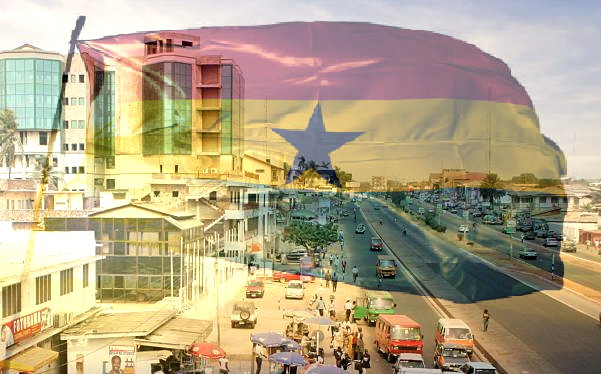
When afternoon sun settles over Accra, traders in Madina, Makola, Central Accra, Circle, Tema, etc., shift their tables inch by inch chasing the last patch of shade. In Tamale, transport operators wrap handkerchiefs around their heads. In Cape Coast, parents complain that children return from school too exhausted to concentrate. Across Ghana’s fast-growing cities, residents say the same thing that the heat no longer feels normal.
Ghana’s urban centres are expanding at breathtaking speed, from Madina to Sekondi-Takoradi; from Osu to Tamale and so on. Fast-paced concrete urbanization rising where wetlands once absorbed rainwater. Schoolyards are paved for parking. Housing estates are maximizing plots of lands, without the consideration of trees. And alongside these developments, something else is rising quietly, the dangerous urban scorching heat. Making it appear like urban growth is trapping-down heat.
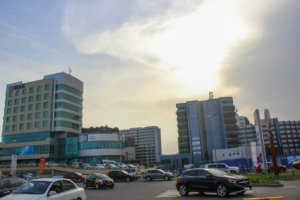
Scientists call it the urban-heat-island effect; an instance when developed areas become significantly hotter than surrounding rural communities. Even though concrete and asphalt absorb heat during the day and release it slowly at night. And mostly because trees that usually cooled the air through shade and evapotranspiration, are now removed largely because real-estate advancement. Airflow is blocked by dense buildings. Moreso, vehicles and air conditioners generate even more heat. Besides, human bodies also generate heat. According to the Ghana Meteorological Agency and climate data referenced by the World Bank Climate Knowledge Portal, Ghana’s mean temperature has risen by about 1°C since the 1960s. In cities like Accra, rapid urbanisation intensifies that heat-up locally.
The Intergovernmental Panel on Climate Change warns that West Africa is among the most climate-vulnerable regions in the world. Still, Ghana’s urban planning systems often treat trees as ornament, instead being seen as essential infrastructure. So, there is ravaging heat in most accommodations.
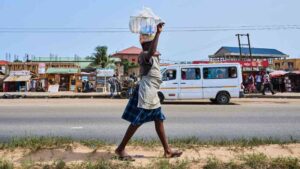
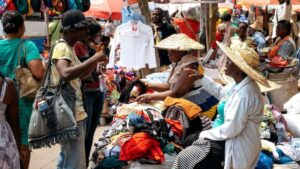
In entreat this scenario, one should note that the consequences are personal before they turn political. In dense neighbourhoods such as Ashaley Botwe, Dansoman, Ashaiman, parts of Madina, etc., residents describe afternoons as unbearable, and nights, not cool enough to recover. Families without air conditioning their homes, rely on cross-ventilation and shade, which are both increasingly scarce relaxing-commodities.
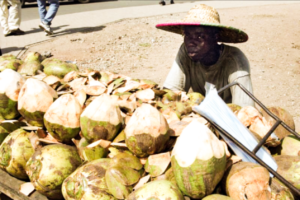
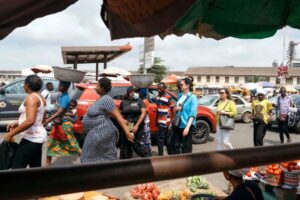
Informal workers such as market women, kayayei (head porters), street vendors, drivers, conductors, etc., heat is not an inconvenience, but an occupational hazard; because many of these traders/informal workers, spend 8 to 12 hours outdoors with little or no structured shading. And prolonged exposure increases dehydration risks, fatigue, heat stress, you name it onward. Most of these small business people can’t afford to stay off their daily trading, as non-productivity translates directly into no-income.
Furthermost, a great number of parents report that their children struggle to focus in overheated classrooms. Health professionals note spikes in heat-related illnesses during peak dry seasons. Electricity demand surges as households demand turn to fans and air conditioners, straining already pressured power systems. In other words, urban heat is no longer just an environmental issue. It is an issue affecting families, a public health, weather condition and even national economy. Painfully, existing natural cooling system are disappearing on the rapid conduction of real-estate progress.

Accra’s wetlands that was once natural air conditioners and flood buffers in time past, have steadily been reclaimed for residential and commercial projects. Open spaces like non-structure playgrounds for neighbourhoods children, are shrink as land values rise. Rampantly, full-grown trees are being cleared-off during construction; and are replaced with car-port canopy, which is the new-normal equivalent to tree planting now.
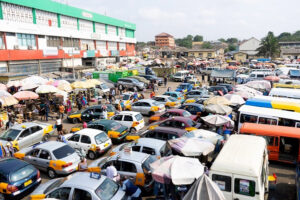
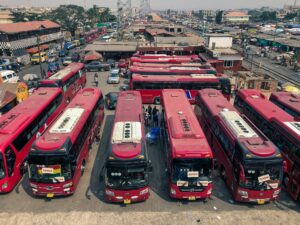
Markets and lorry parks, where thousands gather daily, are often designed without permanent shade structures. New estates prioritise paved surfaces over green corridors. Communities increasingly associate rising temperatures with weak enforcement of development controls and poor protection of green spaces, meanwhile some of their dwellers are culprit for felling trees for one use or the other.
Global research shows urban vegetation can reduce surface temperatures by 2-8°C. That difference can determine whether a city remains liveable or becomes hazardous from heat-related complications. Nonetheless, there are other cities in developed countries that have faced similar pressures and responded differently.

In Singapore’s rapid urbanisation in the 1960s, led to a deliberate development of City-in-a-Garden strategy. Today, nearly half the island is covered by greenery, integrated into transport corridors, rooftops and vertical spaces. This shows that governmentally, greenery should be embedded into law, not left to voluntary campaigns alone. Melbourne has adopted an Urban Forest Strategy to expand canopy cover and reduce heat stress. Medellín built green-corridors that lowered temperatures while improving safety and air quality. Paris is planting thousands of trees to shield residents from intensifying heatwaves. All these cities recognise a critical change in climate change and resistance, and as such, remodify their cities with high consideration for humanity. Showcasing the positive marriage between politics and governance.
Ghana’s urban population now exceeds 56% of the national population. The direction of her city growth, will determine whether urban centres become engines of prosperity or heat traps. The governance challenge shouldn’t be to plant ceremonial seedlings each rainy season. It should be to enforce canopy standards in development permits. One that will enable the protection of full-grown trees in the process of seeking approval for construction. Furthermore, integrating green buffers into zoning laws; and designing budgets in place for constant maintenance. Urban greenery must move from symbolic campaigns to enforceable policy.
Communities are already demanding accountability. Residents increasingly question why green buffers are ignored in estate approvals. Civil society groups argue that environmental impact assessments, often fail to translate into visible tree protection. Urban heat is becoming a governance issue, because it exposes planning-weaknesses in ways citizens can physically feel.
The business case for shade/greenery and the clear economic argument: heat reduces labour productivity and increases healthcare costs. It drives higher electricity demand and strains national grids. Shaded streets encourage walkability, support small businesses and improve property values. In cases like this, nature-based solutions are repeatedly identified by climate scientists as cost-effective adaptation tools. A shaded city or urban areas, are productive territories. But, there has to be a choice about the future.
Ghana does not need to replicate Singapore’s model, because ecological and financial contexts differ. But then again, the principle is universal; treat green space as infrastructure. There are tree suggestive urgent-steps stand out for Ghana to look into: Protect existing mature trees before planting new ones; Mandate minimum green coverage ratios in development approvals; and Prioritise shading in high-exposure areas like markets, schools, pedestrian routes, transport hubs, recreation centers, etc.
If Ghana continues reclaiming dry-lands from wetlands/water, clearing canopy cover and sidelining green planning, it risks engineering hotter, harsher and more unequal cities. And for most families seeking relief from sleepless nights, traders enduring long afternoons and children learning in overheated classrooms, the solution is both simple and strategic if government enforcement will prevail the call for planting/protecting trees; and/or making it a part of the law. Because in a weather-heated-Ghana, green spaces are not decorative luxuries, they are climate-insurance that the premium is overdue.