

NASA’s Jellyfish Study Leaves Questions About How Life Adapts in Space
In the early 1990s, a little-known experiment conducted by the United States space agency, NASA, quietly sent thousands of baby jellyfish into orbit. The goal was unusual but profound: to explore whether humans born in space might struggle to sense gravity if they later returned to Earth.
At the center of the experiment was biologist Dorothy Spangenberg, whose research team launched nearly 2,500 jellyfish polyps aboard the space shuttle Space Shuttle Columbia in 1991. Over nine days in microgravity, the tiny organisms multiplied dramatically, producing roughly 60,000 juvenile jellyfish.
The choice of jellyfish may appear strange at first glance. But scientists saw them as a valuable biological model. Like humans, jellyfish possess a simple system for detecting gravity. When jellyfish mature into their familiar bell-shaped “medusa” stage, they develop small crystals of calcium sulphate inside their bodies. These crystals move when the animal shifts direction, brushing against specialized hairs that send signals to neurons. The process allows the jellyfish to determine whether it is swimming upward or downward.
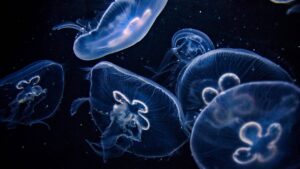
Humans rely on a comparable mechanism. Inside the inner ear are tiny calcium carbonate structures that move with gravity and stimulate hair cells, enabling the brain to interpret balance and spatial orientation. Researchers wanted to know whether this gravity-sensing system could develop normally in space. The findings were striking. Although the jellyfish raised in orbit formed the same crystals as those on Earth, they struggled to swim properly once they returned to the planet’s stronger gravitational pull. Scientists observed irregular movements and “pulsing abnormalities,” symptoms similar to vertigo.
The results hinted a deeper concern for the future of human space settlement. If jellyfish raised in microgravity had difficulty adapting to Earth’s gravity, what might happen to people born and raised in space habitats or on distant worlds?
The experiment also sparked broader scientific and ethical discussions. While the study offered important insights into human physiology, it raised questions about the limits of using living organisms in space experiments. Animal research has long been part of space exploration, but critics argue that the push to understand life beyond Earth must also consider the welfare of the creatures involved.
Beyond the laboratory, the implications reach into politics and society. As governments and private companies accelerate plans for long-term space habitation, the prospect of children being born away from Earth is shifting from science fiction to policy debate. Scientists, ethicists, and lawmakers are increasingly grappling with questions about health, identity, and even citizenship for future generations who might grow up under different gravitational conditions.
The jellyfish experiment did not provide definitive answers. But decades later, it remains an early warning that life shaped in space may not easily adapt to Earth. As humanity looks outward to the Moon, Mars, and beyond, the humble jellyfish serves as a reminder that the biological challenges of leaving our home planet may be far more complex than rocket science alone.