

Swiss Nanofilter Offers New Hope for Alzheimer’s; But Insurance Barriers Keep It Out of Reach

In a development that is reigniting debate over how societies treat Alzheimer’s disease, Swiss bioengineers have unveiled a blood-filtration technology that can remove the toxic proteins linked to dementia in a matter of hours. Early clinical results suggest that some patients with moderate Alzheimer’s experienced measurable cognitive improvement within weeks. This is an outcome that challenges long-held assumptions that the disease can only be managed, not reversed.
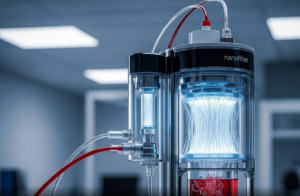
The technology relies on nanofilters designed with pores small enough to capture amyloid-beta and tau proteins, the molecular debris that accumulates in the brains of people with Alzheimer’s. During a four-hour outpatient session, a patient’s blood is circulated through a cartridge that selectively traps these proteins while allowing healthy blood components to pass through. As the blood is cleaned, the brain gradually offloads excess proteins to restore balance across the blood-brain barrier. Patients typically receive twice-weekly sessions for two months, followed by periodic maintenance.
With respect to many families living with dementia, the potential human impact is profound. Alzheimer’s steadily erodes memory, independence, and relationships, often forcing loved ones into full-time care. Researchers report that many patients not only improved on cognitive tests, but were able to resume everyday activities like holding conversations, managing routines and reconnecting socially after treatment. As for caregivers, this could mean relief from emotional exhaustion and the chance to see a parent or partner return after years of decline.

Yet, the innovation has collided with political and economic realities. Insurance providers, including public systems abroad, classify the nanofilter therapy as experimental. They decline coverage despite Swiss clinical data indicating significant patient improvement. Critics argue that reimbursement rules favor long-term management, nursing homes, medications and ongoing care, over one-time interventions that could reduce lifetime costs and restore independence. Insurers counter that broader trials and regulatory approval are necessary before changing coverage policies.

The controversy highlights a deeper social question: how quickly should health systems adapt when disruptive technologies blur the line between treatment and cure? In the United States, families continue to shoulder enormous costs while approved Alzheimer’s drugs offer modest benefits. Advocates say the Swiss breakthrough exposes a gap between scientific progress and policy response, where caution, cost control, and profit incentives can slow access to care.

As populations age and dementia cases rise worldwide, the nanofilter debate is no longer just about one device. It is about who decides the lives that are worth restoring; how health systems balance innovation, risk and responsibility, when hope arrives faster than policy can keep up.