

Afreximbank Recasts Regional Leadership, Promoting Africa-Caribbean Trade Leverages

On August the 31st, 2026, in Cairo, Egypt, the African Export-Import Bank (Afreximbank) reshaped its regional leadership structure, with a series of senior appointments aimed at bringing decision-making closer to the markets, strengthening client relationships and sharpening the institution’s response to Africa’s evolving trade and development needs.
The appointments is an indication that shows Afreximbank is seeking to translate its expanding continental mandate, into stronger regional executions. Apart from filling executive positions, the changes shows an effort to align leadership more closely with the political, economic and commercial realities of individual markets, across Africa and the Caribbean.
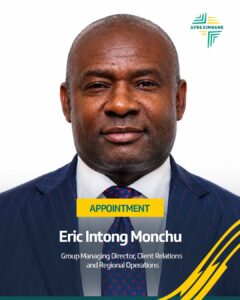
In the heart of the reshuffle, ERIC INTONG MONCHU is appointed Group Managing Director – Client Relations and Regional Operations, in Cairo after serving in an acting capacity for a while. His mandate places him in the connection of client engagement, regional coordination and transaction delivery, in areas that are progressively critical, as African economies pursue extensive intra-African trade and industrial integration.

The regional changes extend across the continent. KUDAKWASHE MATEREKE, was moved to Abuja as Director of Regional Operations, Anglophone West Africa, after leading operations in East Africa. HUMPHREY NWUGO took charge of Eastern Africa, from Kampala, following his work in Southern Africa, while PETER ADESHOLA OLOWONONI was upgraded to Director – Regional Operations, Southern Africa, with his base in Harare.
In the Caribbean islands, ROY REID was appointed to the office of Chief Operating Officer of Afreximbank’s Caribbean Office in Bridgetown, bringing to bear his more than two decades of experience, spanning government advisory, financial services, investment management, fintech and business development. These are all leadership appointments transcending boardrooms.
The significance of these appointments, extends beyond corporate hierarchy. In a development-finance institution with a continent-wide political and economic directive, leadership placement can influence how quickly capital reaches businesses, the ways effective governments and private-sector actors are engaged; and the manner regional priorities are translated into bankable transactions.

The move also highlights the importance of delegational leadership, giving regional executives sufficient authority, market knowledge and institutional backing to respond to local opportunities, as well as aligning with the Bank’s better-quality strategy.
Perceptually, in Afreximbank’s concerns, this dimension of regional designation is particularly important, as African markets differ sharply in infrastructure needs, regulatory environments, industrial capacity, etc. access to finance. A highly centralised approach, can create some gap-distance between institutional strategy and commercial realities that stronger regional leadership can help close.


Most of the newly appointed executives have risen through Afreximbank’s own ranks, giving the institution service-continuity, allowing it to redistribute responsibilities across regions. Their familiarity with the Bank’s systems, clients and strategic objectives, could help reduce the learning curve and accelerate execution.
President and Chairman of the Board of Directors, Dr. George Elombi, said the appointments demonstrated the depth of professional talent within the institution, reinforcing its commitment to change the structure of African trade.

Conversely, the market that these newly appointed captains will serve, is watching to see how effectively their leadership will convert Afreximbank’s ambition into measurable outcomes, from greater intra-African commerce/industrialisation, to stronger Africa-Caribbean economic ties.
In this sense, Afreximbank’s latest leadership transition surpasses a mere internal corporate exercise. It is a strategic stake on regional proximity, delegated authority and experienced leadership, as instruments for turning Africa’s developmental agenda into transactions, partnerships and tangible economic opportunities.
Source: Afreximbank