
Climate Education as a Key Driver of Promoting Sustainable Development
As climate risks intensify and policy timelines shrink, education is emerging not as a supporting actor but as a central driver of sustainable development, as one with immediate human benefits, economic potential and political consequences that reach from classrooms to national planning.
Across countries, policymakers and educators are increasingly treating climate change education and Education for Sustainable Development (ESD) as core curriculum priorities rather than optional subjects. The shift reflects a growing recognition that schools do more than transfer knowledge: they shape behavior, influence livelihoods and build the civic capacity needed to respond to environmental and economic shocks.
At the human level, the impact is already visible. In communities where climate education is paired with hands-on learning such as school gardens, waste recycling initiatives or small-scale renewable energy projects, students are not only learning concepts but applying them in daily life. Families benefit from reduced energy costs, improved food security and better waste management practices. In low-income areas especially, these practical skills translate directly into resilience, helping households adapt to rising temperatures, erratic rainfall and resource scarcity.

Educators say this experiential approach is critical. Traditional classroom instruction alone has struggled to change behavior, but when students participate in community-based projects, the results are measurable: higher rates of environmental stewardship, stronger civic engagement and increased awareness of how local actions connect to global challenges.
Economically, the implications are equally significant. Embedding sustainability into education systems, is helping to build a future workforce equipped for green industries, such as from renewable energy and sustainable agriculture to environmental management and climate technology. Analysts note that countries investing in climate education today are effectively preparing their labor markets for the transition to low-carbon economies, reducing future unemployment risks while opening new sectors for growth.
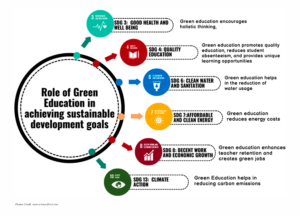
At the grassroots level, schools are also becoming micro-centers of innovation. Partnerships with local businesses, NGOs and municipal authorities are enabling students to work on real-world problems, from designing energy-efficient solutions to improving local water systems. These collaborations not only enhance learning but stimulate local economies by creating demand for green services and technologies.
However, progress remains uneven. In many regions, limited funding, inadequate teacher training and resistance to curriculum reform continue to slow implementation. Teachers often lack the tools and confidence to deliver interdisciplinary climate content, while fragmented policies leave sustainability education under-prioritized.
To address these gaps, governments are being urged to align education policy with climate and development goals. This includes investing in teacher training, integrating sustainability across all subjects and adopting clear national standards that measure both learning outcomes and behavioral change. International frameworks and partnerships are increasingly guiding this process, offering models for scaling successful programs.

The political dimension is becoming harder to ignore. Education is shaping not only individual choices but public expectations. A generation equipped with climate literacy is more likely to demand accountability, support sustainable policies and participate in civic decision-making. In this sense, classrooms are evolving into spaces of civic empowerment, where future voters, workers and leaders develop the tools to influence national and global agendas.
Technology is accelerating this shift. Digital platforms, simulations and online courses are expanding access to climate education, particularly in underserved areas. When combined with local, hands-on learning, these tools are helping bridge knowledge gaps and making sustainability education more inclusive. Still, experts caution that digital solutions must be deployed carefully to avoid widening inequalities where access to devices and connectivity remains limited.

Ultimately, the push to embed sustainability in education reflects a broader recalibration of development strategy. Rather than treating climate action as a standalone sector, governments and institutions are beginning to recognize education as the foundation upon which long-term environmental, economic and social outcomes depend.
With great consideration, the stakes are immediate for most communities on the frontlines of climate change. But, the message is increasingly clear for concerns policymakers. As such, investing in climate education is not just about awareness, but equipping societies with the skills, resilience and political agency needed to navigate an uncertain future