
Nigeria’s Rising Debt Burden Pushes Businesses to the Edge of Credit Exclusion
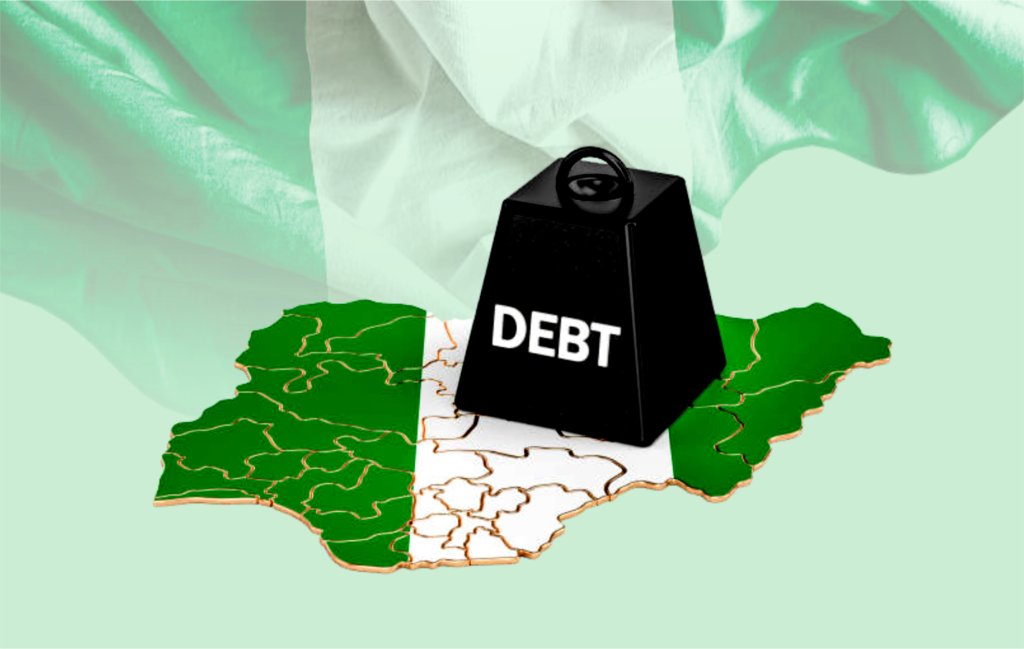
As Nigeria’s public debt climbs to record-high levels, a growing number of businesses are finding themselves shut out of affordable credit, expanding concerns that the country’s borrowing strategy is squeezing the productive sector, while worsening economic hardship for masses.
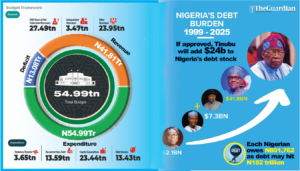
By early 2026, Nigeria’s total public debt had risen beyond ₦159 trillion, driven largely by aggressive domestic borrowing that is used to finance widening-budget deficits and the repaying of maturing obligations. Presently, the economy is hanging on a warning-anchor that the flaring-consequences are now spreading past the government balance-sheets into factories, markets, farms-economy and ultimately, into households. Commercial banks that traditionally are expected to finance private investments/SMEs, are increasingly channeling funds in the direction of government securities, which to them is viewed as safer, more profitable channel. Volcanically, the result is a tightening credit environment for businesses already battling inflation, weak consumer spending, energy costs and currency instability.

Picture Credit: Punch Newspapers
Picture Credit: TheGuardian – https://guardian.ng
Presently, borrowing for many SME enterprises, has become nearly impossible. Lending interest rates in Nigerian banks currently hover between roughly 15% to over 40% per annum, with average commercial bank lending rates sitting at 19.29% as of February; and its forcing manufacturers, traders and service providers to shelve expansion plans, cut staff, or operate below capacity.
Across industrial clusters in Lagos, Kano, Aba, Ibadan, Abuja, Kaduna, Port Harcourt, etc., business owners say access to working capital has become one of their greatest survival challenges. Several operators report that banks now demand stricter collateral requirements, while offering shorter repayment windows, indicating growing fears of loan defaults in an increasingly fragile economy. The impact is filtering down to ordinary Nigerians. Businesses facing high financing costs are transferring those pressures to consumers through rising prices, diluted production-efficiency and job cuts. Unemployment and underemployment also remain persistent concerns, while many informal-sector workers complain that shrinking business activity is weakening local economies.
 Picture Credit: TEKEDIA https://www.tekedia.com
Some economic experts maintain that the situation is a structural dilemma, caused by naira devaluation, continuous rising inflation and the government borrowing that is expanding faster than revenue generation. With debt servicing projected to consume about ₦15.81 trillion in the 2026 fiscal framework, a substantial share of national revenue is expected to go towards loan repayments, instead of being spent on capital projects, healthcare, education, or social investment. This pattern risks creating a cycle, in which the government will continue to borrow to settle existing obligations, leaving little fiscal space for productive development. Even though Nigeria is not yet classified as being in immediate debt distress, concerns are growing over the sustainability of depending heavily on expensive domestic loans.
The political implications are also becoming harder to ignore. Rising economic pressure has intensified public scrutiny of government spending priorities, subsidy reforms, taxation policies and so on. Labour unions and civil society groups have repeatedly cautioned that ordinary citizens are bearing the burden, through inflation and declining purchasing power. However, government officials maintain that borrowing remains necessary to stabilize the economy, fund critical projects, and manage revenue shortfalls.
On the other hand, some policy experts debate on the need to urgently reduce dependence on debt-financed spending by the Nigerian government; and strengthen non-oil revenue collection, export competitiveness, as well as industrial productivity.
 Picture Credit: Proshare
There are also increasing calls for a divergence towards public-private-partnerships (PPP), to finance infrastructure projects, especially in transport, power, housing, etc. Promoters of the PPP idea, say such arrangements could reduce pressure on public borrowing, while attracting long-term private investment into sectors critical for economic growth.
However at the moment, many businesses both small/big, are currently trapped between expensive credit for businesses, low-patronage and demand. This is the reality that portrays the socioeconomic cost of Nigeria’s growing debt burden. According to some opinions, unless government borrowing begins to translate into measurable productivity, development and inclusive growth, the country risks expanding a cycle where debt-growth and economic hardship will keep rising together.