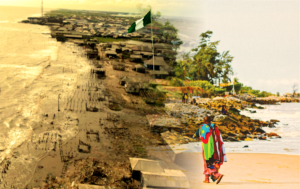

Nigeria Coastline Under Vanquishing-Pressure as Ocean Visits Land
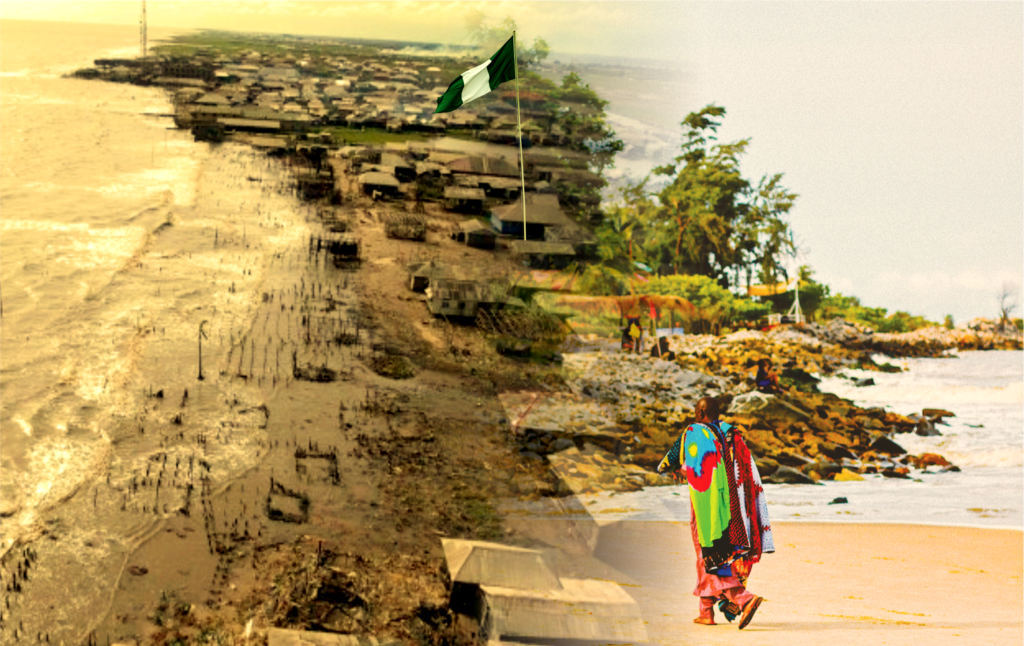
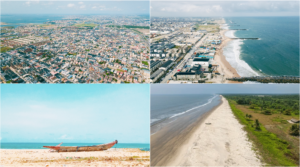
Down through the years, fishing communities along Nigeria’s Atlantic coastline have built their lives around the sea. Nigeria has an estimated coastline of 853-kilometre along the Atlantic Ocean and Gulf of Guinea, stretching across several southern states. Beyond its geographical importance, the coastline is a major economic corridor supporting local fishing in some rural settings, coastal settlements, maritime transportation, commercial ports, oil and gas activities; tourism and a wide range of aquatic businesses.
The coastal belt is also becoming increasingly important to Nigeria’s infrastructure and regional connectivity agenda. Major projects such as the Lagos-Calabar Coastal Highway are designed to improve road links between communities and economic centres along the coast, potentially opening new opportunities for trade, investment, tourism and movement of people and goods.
The country’s coastal states have distinct geographical and economic characteristics. But in places such as Ayetoro in Ondo State and dozens of other settlements scattered across the coastline, the ocean that has been a source of food, income, identity and culture, had just visited ferociously. The same ocean is gradually becoming a rapid advancing threat.
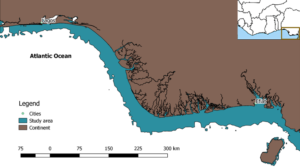
In a summarized-profiling manner, I’d like you to see imaginatively, the stretched coastline across the south-south axis: Lagos State occupies a strategically important position on Nigeria’s southwestern coast. Its barrier-lagoon system includes areas around Lekki and Badagry and supports extensive commercial, residential and maritime activity. The state is also home to major port infrastructure that connects Nigeria to international shipping and trade networks. Ogun State has a relatively short coastal frontage, but its proximity to Lagos and its connection to the western lagoon system, give it strategic importance within the broader coastal economy. Ondo State is characterised by the Mahin mud coast, with historic shoreline communities such as Araromi. Its coastline supports fishing, farming and other activities that depend heavily on the coastal and lagoon environment. Edo State, although having a comparatively limited direct coastline, is influenced by estuarine and low-lying wetland systems, connected to the wider Niger Delta. These waterways, form part of the ecological and economic network linking inland communities with the coast. Delta State is defined by an extensive network of rivers, creeks and rivulets. It is also a major centre of Nigeria’s oil and gas industry, making its waterways important for local communities, energy production, transportation and energy industrial activities. Bayelsa State is one of Nigeria’s most water-dominated territories. Its landscape is characterised by dense mangrove forests, creeks, rivers and tidal channels, connected to the Atlantic. Communities in many parts of the state, rely heavily on fishing, transportation and other water-based economic activities. Rivers State, with Port Harcourt as its principal commercial centre, it occupies a critical position within Nigeria’s maritime and industrial economy. Its extensive waterways, ports and proximity to major oil and gas facilities, make the state one of the country’s most important coastal economic hubs. Akwa Ibom State has a substantial Atlantic frontage, with beaches, estuaries, wetlands and fishing communities, forming important components of its coastal economy. Its location also gives it strategic relevance to maritime trade and the emerging blue economy. Cross River State extends Nigeria’s eastern coastline towards the maritime boundary with Cameroon, with Calabar serving as an important historic port and commercial centre. The state’s coastal environment combines beaches, estuaries, mangrove systems and river networks.
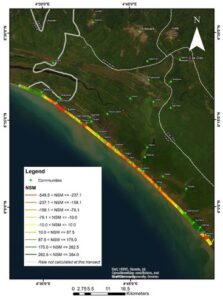
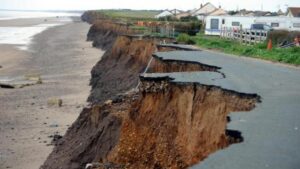
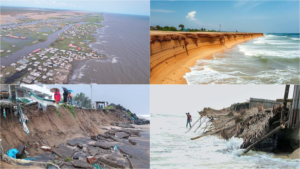
As the ocean visited the land like a shack-loan debt collector lately, houses collapsed into the water. Moreover, roads and public facilities are disappearing. Fishing points are becoming harder to reach, families are repeatedly being forced to abandon their ancestral homes. Coastal erosion is no longer an environmental story discussed at different points anymore, than it’s a daily struggle over survival, securing land and belongings, for residents in this locations.
The crisis is being driven by a combination of rising sea levels, stronger coastal surges and accelerating shoreline erosion. Low-lying communities around the coastal line are particularly vulnerable, as the sea encroaches on land that provided a natural buffer. And irrespective of the numerous reports making rounds, climate change is only part of the story.
Human activity has progressively altered the delicate system that protects Nigeria’s coastline. Sand dredging can remove material that would otherwise help replenish beaches. Expanding cities, roads and other coastal infrastructure, can interfere with natural drainages and sediment movement. Upstream dams may also reduce the amount of sediment reaching the coast, while decades of oil exploration, pollution and mangrove destruction, have also weakened important natural barriers. All of these factors, result into a coastline that is gradually being exposed to the force of the Atlantic.
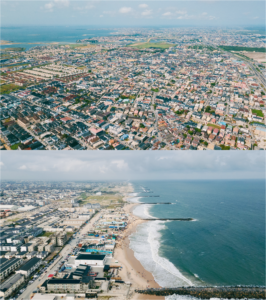
Ayetoro has become one of the most visible symbols of this crisis. Once upon a time a thriving fishing settlement, some sections of the community have progressively been consumed by the sea. It has forced residents to move inland, as the shoreline advances. But Ayetoro is not an isolated case. Across parts of Lagos and the Niger Delta, coastal communities face similar pressures, although the scale and speed vary from one location to another.
But when displacement becomes permanent, affected families lose much greater than a house. They sometime lose their loved ones. A collapsing home may represent decades of savings, family inheritance and ancestral memory. Graves, religious sites, schools, marketplaces and historic structures, can also disappear beneath the waves. Also, when people relocate, they do not simply change addresses; they often lose the physical foundations of their community.
Repeated displacement can create a cycle of insecurity. Families that were depending on rural fishing enterprise, may now have to move into unfamiliar areas where they don’t have their boats, no fishing axis, customers or established networks. Women and children can bear a disproportionate share of the burden. As homefront incomes fall, access to sociocultural engagements, education, healthcare and clean water, would become more difficult. Flipping over, the youths may migrate to cities in search of jobs. These developmental-exoduses, will accelerate the gradual breakdown of traditional coastal communities. Therefore, the erosion of land becomes an erosion of socioeconomic structures.
There is also a hidden public-health crisis. The environmental damage is also creating a growing health challenge. Saltwater intrusion can contaminate freshwater sources; communities will have to depend on expensive or unreliable alternatives. Flooding can create conditions for water-borne diseases. And damaged sanitation infrastructure, compound’s risks.
The economic consequences are equally severe, to fishermen’s families. Boats, nets, landing sites and fish-processing facilities can be destroyed by storms and surges. As coastal ecosystems deteriorate and fish move farther offshore, small-scale fishermen may have to travel greater distances into the sea to fish, which will increase their costs and risks. So, what appears on the map as shoreline retreat, ripples it’s implication against food-security, income and public health.
The politics of a disappearing coastline by a visiting sea-rage, digs for who pays when a community loses its land to the sea? Who determines which settlements receive coastal protection? How are residents compensated when public infrastructure and private property disappear? And what happens when a community can no longer return to the land where its identity was formed? These questions expose a wider tension in Nigeria’s environmental policy; and stipulates the difference between responding to disasters after they occur and preventing communities from reaching the point of collapse.
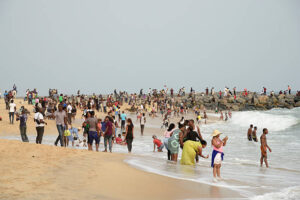
Coastal protection projects, sea walls, drainage systems, mangrove restoration and early-warning mechanisms, can be important interventions. But poorly designed projects can simply shift erosion and flooding to neighbouring communities. The solution, therefore, cannot be limited to concrete structures along the shoreline. It requires coordinated management of the entire coastal system.
On the frontline of diplomatic and regional challenge, Nigeria’s coastal crisis extends beyond national borders. The Gulf of Guinea is a shared ecological and economic space, in the sense that sediment flows, marine ecosystems, fisheries and climate-related risks, cannot be managed effectively by one country acting alone.
Regional cooperation among West African states is very important to curbing this challenge. Governments need stronger mechanisms for sharing coastal data, forecasting extreme weather, protecting marine ecosystems and coordinating adaptation strategies.
At the international level, Nigeria and other vulnerable African countries face a familiar diplomatic challenge: they are among those least responsible for historical global greenhouse-gas emissions, yet their communities increasingly carry the consequences.
That reality, strengthens the case for climate-finance mechanisms that can immediately reach/meet the needs of vulnerable rural communities directly. Adaptation funding must translate into functioning water systems, resilient housing, restored mangroves, safer fishing infrastructure and planned relocation from the part of that is no longer viable.
On the other hand, emergency relief after a community is flooded, is very necessary, but it cannot substitute for long-term plan to beget a lasting solution. Authorities need reliable coastal-risk maps, stricter controls on destructive dredging and development, stronger protection of mangrove ecosystems, better enforcement of environmental regulations and genuine consultation with communities, before major coastal projects are undertaken.
Most importantly, residents must be treated as partners rather than victims. Fishing communities possess generations of knowledge about tides, currents, wetlands and changing weather patterns. Their experiences should inform on coastal planning, alongside scientific data. And as for Ayetoro and other rural vulnerable settlements, time is already running out. The Atlantic is not negotiating with political boundaries, election cycles or bureaucratic delays. Each storm that destroys another home, is each metre of shoreline lost; and a family is forced to relocate, which adds to an expensive crisis, more humanly devastating, the longer it is ignored.
Nigeria’s disappearing coastal communities, are therefore more than victims of climate change. They are a warning about what happens when environmental degradation, weak planning, poverty and global climate pressures converge.
Picture Credit: Tailor & Francis | Science Direct | ResearchGate