

Africa Promotes Debt Guarantees to Unlock Billions of Dollars for Infrastructural Development

Over several decades, Africa’s infrastructure challenge has been measured not only in dollars but in everyday struggles. Unreliable electricity forces small businesses to close early, poor roads leave farmers unable to get produce to markets, congested border posts delay medicine and food deliveries, while inadequate ports and rail links make trade more expensive for consumers across the continent.
Although Africa requires between $130 billion and $170 billion annually to meet its infrastructure needs, investment continues to fall far short, leaving an estimated financing gap of $68 billion to $108 billion every year. Rather than waiting for traditional aid or external loans to fill that void, African governments and development finance institutions are increasingly embracing debt guarantees as a way to attract private investment into critical infrastructure.
The strategy represents a major shift in how the continent finances development. Instead of governments borrowing heavily to fund projects outright, guarantees reduce risks for private investors by protecting them against losses arising from project failure, loan defaults or political instability. That added security makes it easier for pension funds, insurance companies and commercial banks to finance projects that would otherwise be considered too risky.

The approach comes as shrinking foreign aid budgets, mounting public debt and changing global investment priorities force African leaders to seek more sustainable, home-grown financing solutions. “Africans, especially the development banks, decided that we need to take our future and our destiny into our own hands,” said Banji Fehintola, Head of Financial Services at the Africa Finance Corporation (AFC), describing guarantees as a key instrument for mobilising investment at scale.
One of the strongest arguments for the guarantee model is that Africa already possesses substantial financial resources. The continent is estimated to hold nearly $4 trillion in domestic capital through pension funds, insurance companies and sovereign wealth funds. But only a small fraction of those long-term savings is invested in infrastructure, because many projects lack investment-grade credit ratings, required by institutional investors. Guarantees help bridge that confidence gap by improving project creditworthiness and reducing investment risk.
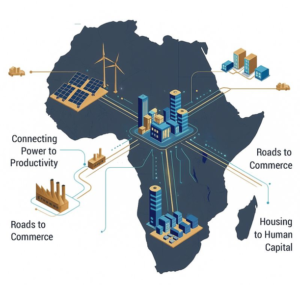
Africans would expect tangible beneficial-evidences, away from this financial markets. More reliable electricity can support manufacturing and reduce business costs. Better roads can connect rural farmers to urban markets, reducing food losses and increasing domestic incomes. Modern ports and border facilities can lower transport costs, make imported goods cheaper, and improve the competitiveness of African exports. Also, improved infrastructure strengthens access to schools, hospitals and essential public services, particularly in underserved communities.
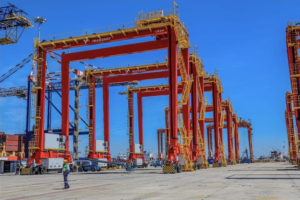
The transformation of the Beitbridge Border Post between Zimbabwe and South Africa, demonstrates how risk-sharing can translate into tangible improvements for millions of people. Previously plagued by severe congestion, commercial truck drivers often spent between 35 and 65 hours waiting to clear customs, disrupting regional supply chains and increasing transport costs.
A $300 million public-private partnership supported by political and commercial risk guarantees from the Export Credit Insurance Corporation of South Africa (ECIC) and Afreximbank enabled African commercial banks to finance the project over longer repayment periods that would otherwise have been impossible.
The results have been significant. Median crossing times have fallen to around 14 hours, reducing delays for businesses transporting food, fuel, manufactured goods and medical supplies throughout Southern Africa.
The project also created nearly 1000 construction jobs. More than 300 permanent operational positions, bring support back to local livelihoods, with women occupying over half of those roles. Faster border processing has strengthened regional trade, improved logistics for businesses and reduced costs for transport operators and consumers alike. The project’s success has encouraged the development of similar border infrastructure partnerships across Southern Africa.
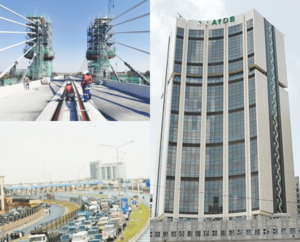
The guarantee model, has gained strong backing from the African Development Bank (AfDB) under its new President – Dr. Sidi Ould Tah, who has placed guarantees at the centre of the bank’s New African Financial Architecture for Development. This strategy aims to leverage the AfDB’s top-tier credit rating, to support far greater volumes of private investment than conventional lending alone could achieve.
International partners are also adapting their support. The United Kingdom has announced a $3 billion guarantee package for the AfDB alongside additional hybrid capital; and the European Union’s Global Gateway initiative and the G7’s Partnership for Global Infrastructure and Investment (PGII), are highly focusing on mobilising private capital for energy, transport and digital infrastructure across Africa. Development organisations including the Private Infrastructure Development Group (PIDG), are expanding guarantee facilities in several African countries to help attract more local currency financing, and reducing dependence on expensive foreign borrowing.


The infrastructure drive is also becoming a better development agenda. Large-scale projects create employment opportunities for engineers, technicians, artisans and construction workers, stimulating local suppliers and small businesses that provide goods and services during construction and operation.
Improved transport networks encourage regional integration under the African Continental Free Trade Area (AfCFTA), enabling businesses to reach larger markets and strengthening economic capacity. Better digital infrastructure can expand internet access, supporting innovation, online education, healthcare delivery and financial inclusion for millions of Africans.
Politically, the growing emphasis on guarantees, reflects a desire for greater financial independence. By mobilising domestic savings and sharing risks with private investors, instead of relying primarily on external borrowing, African countries hope to strengthen fiscal sustainability and maintain greater control over their development priorities.
Despite growing optimism, some experts ring-bells of caution that guarantees are not a cure-all. Many infrastructure proposals still fail during preparation, because of weak project design, regulatory uncertainty and limited technical capacity. The continent also faces a shortage of engineers and skilled workers needed to deliver large infrastructure programmes. There are also concerns that poorly designed guarantees, could encourage excessive risk-taking if project sponsors assume that losses will ultimately be absorbed by governments, or development institutions.
Nevertheless, investors’ appetite appears to be growing. Market participants say well-structured infrastructure projects supported by appropriate guarantees, can achieve the investment-grade ratings sought by international institutional investors, unlocking billions of dollars in long-term financing.
As Africa searches for new ways to close its infrastructure gap, debt guarantees are emerging more than just being a financial instrument. They are becoming a catalyst for better roads, cleaner energy, stronger regional trade and new economic opportunities that can improve the daily lives of millions of Africans, as well as laying the foundation for more inclusive and sustainable growth.