

African Governments and Tourists Against America’s Visa Bond Intersection

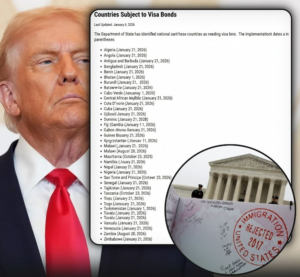
A new layer of financial scrutiny is reshaping the way thousands of Africans approach traveling to the United States, as Washington requires citizens of 30 African countries to post a refundable security bond, when applying for certain business and tourist visas at the US embassy.
Under the current US visa-bond regime, applicants from affected countries who are otherwise eligible for B-1/B-2 visas may be required to provide a bond of $5,000, $10,000 or $15,000, with the amount determined by a consular officer at the time of the interview. The U.S. Department of State says the measure is aimed principally at countries associated with high visa-overstay rates, deficiencies in screening and vetting information, or other concerns identified under the programme.
The 30 African countries currently on the list are Algeria, Angola, Benin, Botswana, Burundi, Cabo Verde, Central African Republic, Côte d’Ivoire, Djibouti, Ethiopia, Gabon, The Gambia, Guinea, Guinea-Bissau, Lesotho, Malawi, Mauritania, Mauritius, Mozambique, Namibia, Nigeria, São Tomé and Príncipe, Senegal, Seychelles, Tanzania, Togo, Tunisia, Uganda, Zambia and Zimbabwe. The policy’s central core, is about a longstanding immigration concern; what happens after a visitor enters the United States.
The Department of Homeland Security’s 2024 overstay data show why the issue has become politically significant in Washington. Several countries now subject to the bond recorded comparatively high B-1/B-2 overstay rates. Angola, for example, recorded a 14.43% total overstay rate among the relevant admissions in the DHS table, while Benin recorded 12.34% and Cabo Verde 13.64%. The figures include suspected in-country overstays and therefore do not mean that every person counted was confirmed to have deliberately violated U.S. immigration law.
Washington’s request for visa bond, is designed as a financial incentive for compliance. It shifts part of the risk associated with non-return, from the American immigration system to travelers. If travelers comply with the terms of the visa bond scheme, the money gets to be returned. If a traveler overstays or violates the conditions, the bond gets forfeited. This logic is straightforward from the government’s perspective. But on ground, the policy raises a more difficult concern: does nationality status proofs that a traveler will be non-compliant to the American immigration system, or be a violator of the US visa regulations?
Earmarked for an affluent traveler is a $5,000 or $15,000 refundable deposit, which may be an inconvenience. To some small-business owners, young professionals, traders, student-supported family or middle-class household in Africa, it can represent months or even years of savings before their recipient can apply for B-1/B-2 visas. The discrepancy is very important, because a refundable bond can still function as a major barrier. Money that is technically recoverable, is money that must first be available. So the people behind the policy idea, should bear a vast sense of consideration in mind.
Consider a Nigerian entrepreneur who wants to attend a trade exhibition in New York, a Ghanaian family hoping to visit relatives, or an African medical specialist invited to a professional conference in the United States… The visa application itself does not guarantee entry. Now, for applicants selected for the bond requirement, access to the visa process will also require substantial capital to be temporarily locked away. Sensitively, this creates a two separate levels or ranks of reality; meaning those with significant disposable funds, may be able to sustain their travelings to the States. Whereas, legitimate applicants with modest incomes, may simply abandon their dreams of touring America for any reason.
The resultant effect could be a form of economic filtering, in which the ability to raise a large deposit, becomes almost as important as the purpose of the trip. And this could be surpassing-consequences the individual traveler.
African governments are worried about the multiple effect of this US visa policy, as they are faced with a diplomatic dilemma. They have a responsibility to cooperate with international immigration rules and to address genuine problems involving overstays, document fraud and irregular migration. But they also have an interest in protecting the ability of their citizens to participate in international commerce, education, tourism, professional exchanges and family life.
Governments of some of these affected countries that are already trying to attract foreign investment and expand exports, this policy comes as restrictions on movement to meet with their prospective actors; and it can become an indirect constraint on economic diplomacy. Trips to woo-in investors, is often not simply a holiday. It always turn out to become the beginning of a commercial relationship, or a supplier agreement chain, an investment visit or a technology partnership.
A small African company seeking American equipment, software, financing or customers, may need its owner to travel before a deal can be completed. If that trip becomes prohibitively expensive, the opportunity may disappear before it reaches the negotiating table. The same applies to American businesses. Consequently, it is not one-sided. America could also feel the economic consequences. For the reason that the consideration is bigger than just immigration enforcement.
On a wide-range picture, United States benefits economically from foreign visitors. Tourists spend money on hotels, airlines, restaurants, transportation, entertainment and retail. Business visitors attend conferences, negotiate contracts, meet investors and develop commercial relationships. If the bond discourages legitimate travelers, American businesses that depend on international visitors could lose some of that activity.
There is also a less visible cost, loss of socioeconomic networkings. Most international businesses are often cemented on face-to-face relationships, and built onward based on physical contact. A first meeting can lead to a contract; a conference can lead to investment; a university visit can lead to research cooperation; and a family visit can sustain diaspora connections that eventually produce economic activity. Also, reducing the opportunity to legitimate traveling, can weaken some of the informal economic bridges/trade that connect American cities with African markets.
On the African side of the equation, the potential impact could be even more pronounced, for African economies. Africa’s growing middle-class are gradually surging their participation in international tourism, entrepreneurship, professional training and cross-border commerce. International traveling-ease, is skeletal-part of that economic expansion.
A barrier placed on accessing American visa because of visa bond, would not necessarily stop migration pressures. Instead, it can encourage people to seek alternative destinations, conduct business remotely or abandon the US international opportunities altogether. That could benefit long awaiting competing global markets too.
If an African entrepreneur finds it easier and cheaper to attend a business meeting in Europe, Asia or the Middle East than in the United States, the commercial relationship may gradually shift away from America. The United States could consequently face a paradox; a policy designed to protect the country from immigration violations, could also make the country less accessible to legitimate African business and investment networks.
The social-construct consequences are harder to measure. Families may be paying an invisible price besides the scene. As for African families with relatives living in the United States, international travel is often about more than tourism. It can mean attending a wedding, visiting an elderly parent, supporting a sick relative, meeting a newborn child or maintaining relationships across generations.
A large financial requirement can turn such visits into decisions, to check if a family can afford to temporarily immobilize thousands of dollars as much as the requirement. Even when the money is tailored to be eventually refunded, families in this stead must bear the risk of waiting for reimbursement.
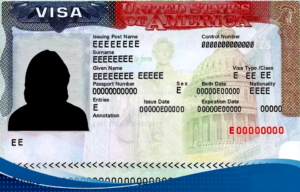
The State Department says applicants should only post the bond after receiving direct instructions from a consular officer, using the US Treasury’s Pay.gov system. It also warns applicants not to pay through third-party websites. This warning is particularly important in countries where visa applicants already face exposure to fraud and unofficial intermediaries. Similar policies involving large sums of money, creates opportunity for scammers to exploit people who are desperate to travel.
In all these diplomatic back-and-forth, the most contentious issue may ultimately be one of fairness. The United States maintains that the bond is based on measurable immigration risks rather than an indiscriminate ban. That distinction matters. The policy does not automatically deny every applicant from an affected country a visa; rather, eligible B-1/B-2 applicants may be required to provide a financial guarantee. But from the perspective of an ordinary applicant, nationality can still determine if thousands of dollars must be produced, before visa approval/traveling to the US become possible.
Question! Should some immigration misconduct of some travelers, inject a financial burden for all other decently-eligible applicants from the same country? I guess there might not be any form of a simple answer. Although, every governments have legitimate reasons to protect their borders, enforce immigration law and demand compliance from visitors. But governments of the affected African/non-Africa countries, should equally have legitimate reasons to query the American government that if a visitor’s overstay in the US, should warrant punishment on legitimate travelers, weaken US commercial windows to Africa, educational and cultural opportunities.
However, the visa-bond controversy also exposes an intense problem in international migration policy. Overstays are not created solely by the decisions of individual travelers. They can be influenced by incomparable socioeconomy between the US and he supposed traveler’s country; also, part of the issue too comprise unemployment, political instability, family networks, recruitment practices, the enormous gap in earning opportunities between countries, comparative differences in minimum wage, power of affordability, etc.
Overall, the financial visa-bond will address one part of that equation, as an incentive to enforce prospective traveler to return-back home when required to. But, it can never address the economic conditions that makes a prospective traveler remain abroad beyond visa expiration time, seeking to regularize his/her residency papers in the longrun. Hence, this ‘given’ traveler could defiantly ignore the visa bond, as his/her incentive for a “greener-pasture”, in the US.

As a dare to governments of the affected African/non-African countries, resolving the other part of the equation will mean improving national economy, generate employments, incomes, upscale minimum wage, provide security, create socioeconomic opportunities, provide enabling environment, etc., which are cardinal to reducing irregular migration, back home. From Washington’s viewpoint, it means immigration enforcement must be balanced against the economic and diplomatic value of maintaining legitimate channels for travel.
The US Department of State, has simultaneously been tightening visa administration in Africa, including a relocation to regional visa hubs according to the department, is all intended to strengthen screening, standardize adjudication and align consular resources with US national interests. The emerging picture is therefore not simply one of a visa bond. It is a sweeping restructuring of traveling from Africa to America.
Nonetheless, on this note, Washington’s objective is to assert greater control over which visitor(s) enters America and whether he/she leaves as at when due. And from African governments, the challenge will be to prevent immigration concerns from becoming barriers to their trade, investment and human networks from America. In respect to the general travelers, the visa-bond policy is barraged with the following queries – can I afford the visa applications requirement? Can I afford to prove that I deserve to get an America visa?