

Ethiopia’s Economic Retuning, State-Led Growth to More Diverse Market-Driven Economy
Addis Ababa, Ethiopia, is undergoing one of the most consequential economic transformations in its recent history, moving gradually from a state-dominated agriculture-dependent model towards a more diversified economy in which private investment, capital markets and digital services play a larger role.
The transition is being driven by the government’s Homegrown Economic Reform Agenda, which seeks to liberalize markets, attract private capital, strengthen institutions and reduce the country’s vulnerability to external shocks. Opening markets and broadening growth within.
Several sectors that was once largely closed to private participation, have been opened to greater competition. Telecommunications, banking, real estate and capital markets are among the areas undergoing reform, while the launch of the Ethiopian Securities Exchange (ESX) has restored organized securities trading, after a decades of silence.
The economy is also becoming less dependent on traditional agricultural exports, such as coffee. Mining, manufacturing, renewable energy, tourism and services are emerging as additional sources of growth. Agriculture itself is being transformed. Expanded irrigation and commercial farming have helped Ethiopia dramatically increase wheat production, strengthening domestic food supply while creating the possibility of greater exports.

At the same time, the country’s digital economy is expanding. Mobile broadband, digital public services and large-scale digital-skills programmes, are bringing more citizens and businesses into the formal digital economy. Another chapter is the debt restructuring that has opened a new episode.
The economic reforms are unfolding alongside a major effort to restore Ethiopia’s financial stability. After defaulting on its $1 billion Eurobond in December 2023, Ethiopia reached an agreement in principle with private bondholders that provides for a 12% reduction in the bond’s principal, cutting the debt from $1 billion to $880 million. The restructured bond carries a 6.15% interest rate and matures in July 2029; and Ethiopia is also expected to settle roughly $99 million in accumulated interest arrears.
A distinctive feature of the agreement is a new-money warrant, giving bondholders the possibility of subscribing to a future Ethiopian Eurobond of up to $1 billion, subject to market conditions. The arrangement is designed to help bridge differences between Ethiopia and its creditors, although it will preserve future access to international capital markets.
The wide-range restructuring with official creditors, covers about $8.4 billion of external debt. Rather than cutting principal, bilateral creditors are providing large relief through extended maturities, helping Ethiopia to reduce pressure on government finances, in the near term.
Successful implementation remains closely connected to Ethiopia’s International Monetary Fund (IMF) programme and its extensive effort to restore investor confidence, which will help their capital markets to take a deep root.
The launch of the ESX on January 10, 2025, marked another milestone in the country’s economic opening. The exchange has begun building an equity market around major Ethiopian companies, with banks such as Wegagen Bank, Gadaa Bank, Awash Bank and Bank of Abyssinia, among early participants. State-owned Ethio Telecom became a major landmark listing, after attracting more than 47,000 local investors.
Trading on the equity market has since passed 1 billion birr. Besides, the exchange is developing its first stock-market index to improve transparency and provide investors with a benchmark for market performance. In addition, the exchange’s fixed-income and money-market activities have developed, even faster. Its interbank money market has facilitated hundreds of billions of birr in transactions, while electronic Treasury-bill trading is creating new channels for domestic investment.


Nonetheless, the transition faces cultural and institutional barriers. Many Ethiopian companies remain closely held and have limited experience with public disclosure, corporate governance and investor scrutiny. Building a professional ecosystem of brokers, investment advisers and underwriters, is another challenge for a market being constructed almost from scratch.
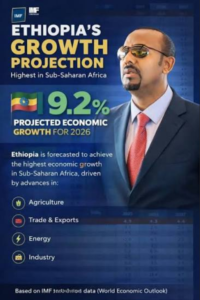
In considering a high growth but uneven gains, the Ethiopian reforms are occurring against a backdrop of strong economic expansion. IMF projections cited in the supplied data, places Ethiopia’s real GDP growth at 9.2% in 2026, making it one of Africa’s fastest-growing major economies.
But front-page growth analysis/data, does not eliminate underlying socioeconomic pressures. Inflation and the rising cost of living are still weighing hard on the domestic households frontline. Foreign-exchange shortages, manufacturing constraints and institutional weaknesses, are still banging as significant obstacles. There is also a risk of jobless growth. Moreso, large infrastructure, energy and mining projects can lift GDP substantially, without generating enough formal employment for Ethiopia’s rapidly growing population.

Therefore, Ethiopia’s economic transformation extends farther than just achieving high growth. In its longrun, the durability of her market liberalization, debt restructuring, agricultural modernization, digital expansion and investment in infrastructure, could translate into productive jobs, lower socioeconomic vulnerability and a comprehensive domestic comfortable circumstances.
At the moment, the economic reform is clearly on its right direction. Ethiopia is attempting to replace an economy that is heavily shaped by the state, with a more open and diversified system in which private enterprise and capital markets, have a larger role. The success of this transition could reshape Ethiopia’s economy and position, as one of Africa’s major emerging economic growth destination.