

RECAP: Geography, Institutional Weakness, Political Incentives of Global Powers and Historical Patterns of Prolonged Instability

The seven fault lines of how conflicts in Ukraine, Sudan and Myanmar are reshaping a fractured world. As wars drag on from Eastern Europe to the Horn of Africa and Southeast Asia, a growing number of geopolitical analysts argue that the world is no longer witnessing isolated national crises, but the slow erosion of the international order that emerged after the Cold War.
Against the backdrop of worldwide instability, a controversial but increasingly influential theory is advanced by a Canadian educator, commentator, political strategist and academician – Professor Jiang Xueqin; who describes Ukraine, Sudan, Myanmar, Haiti, Ethiopia, Yemen and the Democratic Republic of Congo as “structural fault lines” of a global system under strain.
Rather than predicting a sudden world war, Jiang warns of something slower and potentially more destabilizing; a prolonged era of fragmented conflicts, humanitarian collapse, proxy rivalries and diplomatic paralysis. He says, the danger is not one catastrophic explosion, but a grinding unraveling that stretches across generations.
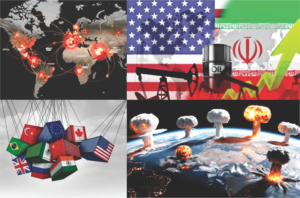
Global conflicts and energy supply disruptions—particularly those linked to the U.S.-Israel-Iran confrontation and security threats to shipping through the Strait of Hormuz—are intensifying economic and humanitarian pressures worldwide. Beyond the broader geopolitical fallout, developing economies and vulnerable households are bearing the brunt of rising import costs, supply chain disruptions, and inflationary pressures.

Economic and Resource Impacts:
- Rising Energy Costs: Disruptions to critical Middle Eastern shipping routes have driven up global oil prices, increasing fuel and energy costs.
- Inflationary Pressures: Higher energy prices are raising the cost of food production, manufacturing, and transportation, driving up consumer prices.
- Growing Poverty Risks: International organizations warn that prolonged energy and supply disruptions could push millions more people into extreme poverty.
Regional Vulnerabilities:
- Supply Chain Disruptions: Emerging economies face mounting import costs as security risks constrain global shipping routes and delay trade.
- Food Security Threats: Conflict-related violence and logistical disruptions are hampering humanitarian food deliveries, worsening food insecurity in already vulnerable regions.

The analysis departs from conventional conflict reporting, focused on battlefield updates or short-term ceasefire negotiations. Instead, he frames the crises through three lenses: geography and institutional weakness, political incentives of global powers and historical patterns of prolonged instability.
In practical terms, the theory suggests that many governments caught in conflict are no longer fully capable of controlling territory, maintaining public trust, or monopolizing armed force. Into those vacuums step militias, foreign mercenaries, regional powers, and competing global interests.
Nowhere is this more visible than in Sudan, where fighting between the Sudanese Armed Forces and the Rapid Support Forces has devastated civilian life, displaced millions, and deepened famine risks. Diplomats across Africa and the Middle East privately acknowledge that no single mediator currently possesses enough influence to enforce a durable settlement.
The war has also exposed broader geopolitical competition. Gulf states, Egypt, Turkish-aligned interests, and Russian-linked networks have all been accused by observers and humanitarian groups of pursuing strategic leverage while civilians bear the cost.
The ordinary Sudanese families, see the geopolitical chessboard translating into collapsing hospitals, empty markets, interrupted schooling and dangerous migration routes across North and East Africa. In Myanmar, the military junta continues to face armed resistance years after the 2021 coup. Entire communities have been displaced as ethnic armed groups gain territory and governance structures weaken.
Some analysts say neighbouring China has adopted a pragmatic balancing strategy, prioritizing border stability and economic interests over democratic outcomes. That ambiguity, critics argue, has contributed to a prolonged stalemate rather than meaningful peace efforts.
Ukraine and the limits of great power strategy: The war in Ukraine remains the clearest example of how major-power rivalry can harden conflict rather than resolve it. According to Jiang’s framework, neither Russia nor Ukraine can afford outright defeat politically, militarily, or symbolically. The result is a grinding war of attrition with global consequences far beyond Europe.
African economies continue to feel the aftershocks through rising food prices, energy volatility, fertilizer shortages, and disrupted grain supplies. Diplomats from countries across the Global South have increasingly criticized both Western and Russian blocs for treating vulnerable economies as collateral damage in a wider geopolitical struggle. Meanwhile, the North Atlantic Treaty Organization alliance and the United States face growing questions about strategic endurance, especially as domestic political divisions intensify in Western democracies.
Global powers are operating less from ideology than survival instincts. Washington seeks to preserve a rules-based order that protects its influence. Moscow seeks strategic buffers and regime security. Beijing aims to demonstrate that Western-led security guarantees are increasingly unreliable while expanding economic partnerships across Africa, Asia, and Latin America.
Africa’s growing exposure: While much international attention remains fixed on Europe and the Indo-Pacific, African states increasingly sit at the crossroads of these geopolitical tensions. Conflicts in Ethiopia, Yemen, and the Democratic Republic of the Congo reveal how fragile governance, competition over minerals and trade routes, climate pressures, and foreign interference can combine into long-term instability.
The implications are deeply human. Refugee flows are straining neighboring countries. Young people face shrinking economic opportunities. Public distrust in institutions is rising. Armed groups increasingly fill gaps once occupied by the state. As for many citizens in conflict zones, international diplomacy appears distant and selective; highly mobilized in some crises, absent in others.
This unevenness has fueled skepticism toward international institutions such as the United Nations, whose peacebuilding mechanisms are often constrained by veto politics among major powers. Perhaps the most troubling dimension of Jiang’s forecast is not the wars themselves, but the weakening capacity of global diplomacy to contain escalation.
He warns that accidental confrontations, rather than deliberate declarations of war, could trigger wider crises. A strike killing foreign personnel, a naval incident in contested waters, or overlapping interventions by regional powers could rapidly test already fragile communication channels.
Several diplomats and conflict researchers share concerns that international crisis-management systems are becoming reactive rather than preventive. Despite the bleak outlook, Jiang stops short of fatalism. He argues that structural pressures are powerful but not irreversible. Political leadership, regional diplomacy, humanitarian investment, and stronger civil institutions could still redirect outcomes.

His historical comparison is not the sudden collapse of 1914, but the drawn-out instability of Europe’s Thirty Years’ War, a period marked by overlapping conflicts, proxy rivalries, economic exhaustion and shifting alliances. However, in regards to communities already trapped inside today’s wars, such historical parallels offer little immediate comfort.
In displacement camps from Darfur to eastern Congo, and in shattered towns from Donetsk to rural Myanmar, the immediate reality is survival: food, shelter, safety, medicine, and the hope that diplomacy can eventually move faster than destruction.
As global powers compete for influence, the deeper question raised by Jiang’s analysis remains unresolved: whether the international system still possesses the political imagination and collective will to prevent fractured states from becoming the foundations of a fractured century.
SOURCE: Prof. Jiang Xueqin’s Submission