

Johann Rupert – Africa’s Second-Richest Man, Departs from FirstRand with $218Million Turnover

Africa’s corporate landscape is quietly reshaping itself as one of its most influential business figures – Johann Rupert, steps back from a long-held banking stake, showing a superior dynamics in how capital is being deployed across the continent and globally.
In March 2026, Rupert’s investment vehicle – Remgro, completed its full exit from FirstRand, selling its remaining 39.6 million shares for about $218.5 million. The transaction closes a deliberate six-year divestment strategy, ending one of the group’s most visible ties to listed financial services. But then, the decision is not as much about departure, but a direction towards a strategic pivot with global-echoes.
Remgro’s exit replicates a growing preference among global investment firms for private markets, where returns can be higher, with strategic control that is more direct. By shifting capital away from publicly traded-banks, the firm is aligning itself with much bigger trend, seen from New York to Singapore, with investors seeking flexibility in sectors such as healthcare, infrastructure, energy, etc.

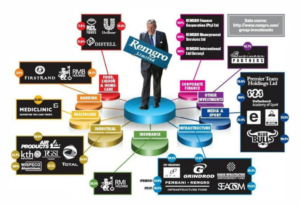
The implications of the exit, are significant to the Africa and financial institution giant. Financial institutions like FirstRand have long been pillars of economic stability, funding businesses, impacting households alike. A reduced presence of legacy investors, could gradually reshape ownership structures, potentially opening space for new entrants, including portfolios like Sovereign Wealth Funds and private equity players. But, it does not exclude the human and economic undertones.
Such high-level financial maneuvers, can feel distant, based on the sensation that will be derived from the diverse corners of the street levels; and their effects ripple outward. Capital reallocation toward private assets often translates into investments in hospitals, renewable energy projects, industrial ventures and son. These are sectors with direct social impact.

By a way of illustration, Remgro’s earlier attempt to delist Mediclinic International, implied a strategy focused on long-term value creation in healthcare, an area where patients’ access, affordability and infrastructure, remain as pressing concerns across Africa. If similar investments follow, communities could see expanded services and jobs-creation, even as traditional banking ownership transits.
In closing the valuation gap, the exit also addresses a persistent challenge for conglomerates, which is market undervaluation. Some watch-a nalysts had pointed to a roughly $2.3 billion gap between Remgro’s asset value and its market price, driven partly by the complexity of its holdings. By simplifying its portfolio and boosting cash reserves, the firm is positioning itself for clearer valuation and more agile deal-making. This also points towards political and market indicators.
Further from the balance sheets, the decision sends a subtle political signal. As African economies navigate currency volatility, regulatory reforms and global capital competition, large-scale portfolio adjustments by influential investors, can influence confidence and policy direction. Governments across the continent, are increasingly keen to attract long-term patient capital, particularly into infrastructure and industrialization. Moves like Remgro’s, may reinforce the idea that Africa’s next growth phase, will be driven in smaller volume by traditional banking stakes, and more by diversified/privately managed investments.
Rupert’s investment-transit playbook, as portrayed by his exit from FirstRand bank, is not an isolated event, but a partial-scene of a wider recalibration in global finance, which is gradually reaching Africa’s corporate essence. With regards to a perceived investors-mentality, it highlights the importance of adaptability. Besides, on the part of policymakers, it underlines the need to create environments where redirected capital can translate into tangible development.
Nonetheless, in respect to the ordinary Africans, the expected reality will be to see these strategic changing-dynamics ultimately delivering a much better access to socioeconomic opportunities, stronger public services and national economic sturdiness.