

Russia Debuts Electronic Warfare System Aimed at Disrupting Starlink via Satellite Antenna Overload

Russia’s new anti-Starlink electronic warfare system, indicates an intensifying contest for control of the electromagnetic battlefield.
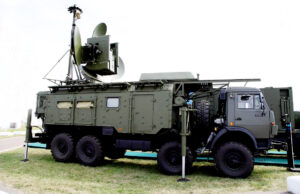
Russia has unveiled and reportedly deployed a new electronic warfare (EW) system, known as Volna Kupol Garant, underscoring the growing strategic importance of space-enabled communications in modern warfare and the escalating technological competition shaping the conflict in Ukraine.
Unlike earlier jamming systems designed to overwhelm satellite terminals on the ground, Volna Kupol Garant reportedly aims directly at low-Earth orbit (LEO) satellites, attempting to disrupt communications by transmitting concentrated, high-frequency interference toward spacecraft overhead. If effective, the approach represents another step in Russia’s long-running effort to degrade satellite-supported military communications that have become central to Ukrainian battlefield operations.
The reported deployment also illustrates a wider geopolitical reality. The war in Ukraine has evolved into a testing ground where governments, commercial space companies and military innovators are adapting one another’s technological advances, attracting close attention from defence planners and diplomatic observers worldwide.
According to available technical descriptions, the Russian system employs phased-array antennas that direct narrow beams toward satellites operating in the 14-14.5 GHz frequency range, commonly associated with Starlink user links. Rather than indiscriminately flooding radio frequencies across large regions, the system reportedly concentrates energy on passing satellites, temporarily, interfering with their ability to receive signals from ground terminals within an operational footprint, estimated at around 20 square kilometres.
The approach reflects Moscow’s comprehensive investment in electronic warfare, an area Russian military planners have regarded as a strategic equaliser, against technologically sophisticated adversaries. Arguably, the electromagnetic dominance is as critical as control on land, air or sea, particularly in conflicts points that are highly dependent on satellite communications, precision navigation and networked command systems.

However, analysts caution that such capabilities also expose important operational limitations. The system’s relatively small coverage area, suggests it is better suited for protecting high-value military positions, than denying communications across entire operational theatres. Its multiple transmitting antennas and substantial power requirements may also generate distinctive electronic signatures, potentially making deployments easier to detect through electronic intelligence and vulnerable to precision strikes, if located.
Reports from the battlefield indicate that Ukrainian forces have progressively targeted high-powered Russian electronic warfare assets, using drones after identifying their emissions. As much as these claims are difficult to verify independently, they highlight the constant cycle of detection, adaptation and counter-adaptation that characterises the conflict.
The emergence of Volna Kupol Garant, also highlights the resilience strategies developed around commercial satellite constellations. Starlink’s architecture differs fundamentally from traditional communications satellites, by relying on thousands of rapidly moving spacecraft rather than a handful of fixed geostationary platforms. That distributed network enables connections to shift between satellites within minutes, reducing the impact of highly localised interference.

SpaceX has previously acknowledged updating Starlink software to improve resistance against electronic attacks, including rapid firmware modifications and techniques allowing terminals to continue tracking satellites, even when navigation signals are degraded. Newer satellite generations also incorporate optical laser links between spacecraft, enabling data to move through space without depending entirely on vulnerable radio-frequency pathways.
These developments have transformed commercial space infrastructure into a highly significant component of modern military communications, raising so much diplomatic and policy questions about the role of private companies in armed conflict. Governments are persistently debating how international law should apply, when commercial satellite networks become integral to military operations, particularly as space assets face growing electronic and cyber threats.
On the battlefield, the contest is way-passed the satellite communications. Ukrainian developers have gradually incorporated autonomous navigation techniques that reduce reliance on continuous radio links. By combining onboard computer vision, pre-loaded terrain mapping, inertial navigation and terminal target recognition, some drone systems can continue missions even when communications or satellite navigation are disrupted. Fibre-optic-guided drones, which transmit commands through physical cables rather than radio signals, represent another adaptation designed to bypass electronic jamming altogether for shorter-range missions.

Meanwhile, Russia has reportedly responded with its own countermeasures, aimed at deceiving highly sophisticated autonomous targeting systems. Military vehicles have been observed using high-contrast geometric paint schemes intended to confuse machine-vision algorithms, while decoy equipment designed to imitate thermal and visual signatures seeks to divert autonomous attacks. Other adaptations include modified silhouettes and multispectral camouflage, intended to complicate automated image recognition.
The result is an accelerating technological competition, in which neither offensive nor defensive innovations remain dominant for long. Each new capability prompts rapid adjustments by the opposing side, shortening the cycle between battlefield deployment and technological obsolescence.
Asides the immediate military implications, the expanding contest over electronic warfare carries wider diplomatic consequences. It reinforces concerns among governments, about the security of commercial satellite infrastructure, the militarisation of space-enabled services and the growing integration of artificial intelligence, into armed conflict. Defence ministries across Europe, North America and Asia, are closely studying developments in Ukraine, as they reassess the future investments in resilient communications, autonomous systems and electronic warfare capabilities.

Furthermore, as concerning Russians, the reported deployment of Volna Kupol Garant, mirrors a strategic effort to challenge an operational advantage that has supported Ukrainian command, intelligence and drone operations. While in respect to Ukraine and its international partners, it underlines the continuing necessity of building redundant, adaptive and extremely autonomous systems, capable of operating in heavily contested electromagnetic environments.
Ultimately, the significance of Volna Kupol Garant lies in its reported technical capabilities and in what it represents; as well as the latest chapter in a seriously complex technological struggle, where dominance is measured by firepower, the ability to control information, communications and the invisible electromagnetic spectrum that progressively defines modern warfare.