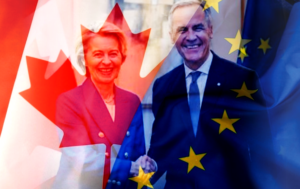

The EU Opens a Partnership Door to Canada, as a New Partnership
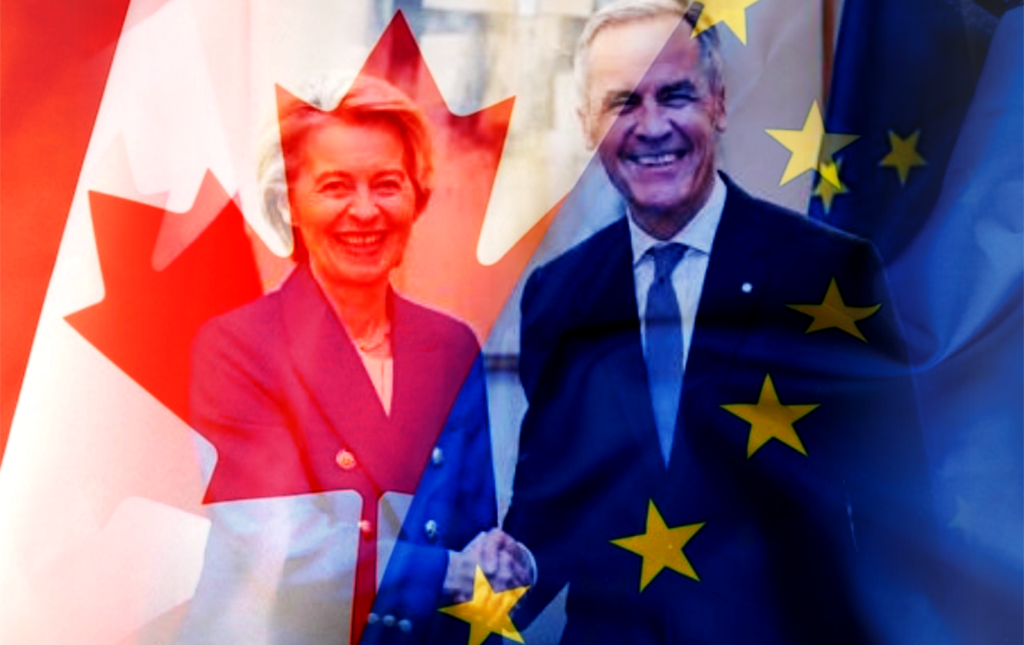
The European Union has opened the door to an unprecedented new form of relationship with Canada, with European Commission President Ursula Von Der Leyen proposing that Canada become the bloc’s first “associate member”.
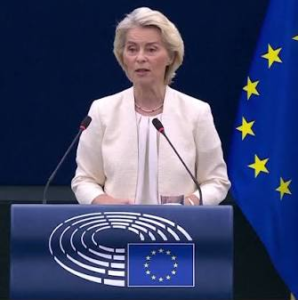
The proposal was made during Von der Leyen’s annual State of the European Union address in Strasbourg on September 16, 2026, with Canadian Prime Minister Mark Carney in attendance. Von der Leyen said she wanted to work with Canada on creating an arrangement that would take the relationship beyond the existing Canada-EU Comprehensive Economic and Trade Agreement (CETA) and toward what she described as an “Alliance for the Future”.
The proposal is significant because “associate member” is not currently an established category of EU membership. Its precise legal and institutional meaning would therefore have to be developed through further negotiations.
That uncertainty is central to the significance of the initiative. Rather than simply expanding an existing diplomatic framework, Brussels and Ottawa would be exploring a new model for cooperation between the EU and a major democratic partner outside the bloc.
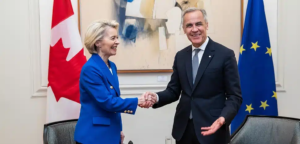
Von der Leyen’s proposal comes at a time, when both sides are reassessing how they build economic and strategic resilience in a more fragmented international system. The proposal was framed against what was described as an ever more hostile global environment.
Her State of the Union address presented Europe as facing a combination of military, political and economic pressures. Russia’s war against Ukraine remains the most immediate security challenge, while European governments are also confronting hybrid threats, pressure on the international rules-based system and intensifying competition over industrial capacity and strategic technologies.
This broader environment helps explain why the EU is looking beyond conventional diplomatic arrangements. For Europe, the challenge is no longer confined to traditional military security. Economic security, critical supply chains, technological capabilities, energy, raw materials and industrial capacity have increasingly become part of the strategic equation.
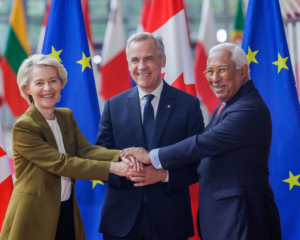
Canada occupies an unusual position within that equation. It is geographically outside Europe but shares many of the political, economic and security interests that Brussels is seeking to reinforce. The proposed relationship is considerably broader than trade.
In her address, Von Der Leyen identified several areas where Europe and Canada could deepen cooperation, including intelligent manufacturing, technology, defence industrial capacity, the Arctic, energy, critical minerals, batteries, artificial intelligence, quantum technologies, cybersecurity and economic security.
There is, however, an important distinction between what Brussels has proposed and how Ottawa has framed the relationship.
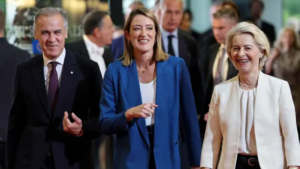
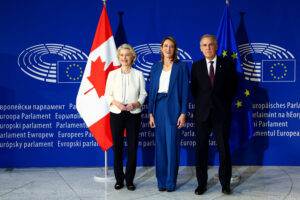
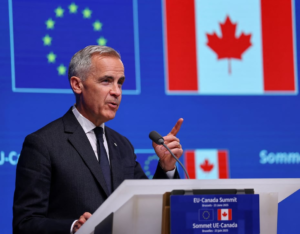
Carney has been pursuing what he calls a unique alliance with the European Union, centred on deeper economic and security cooperation. The Canadian government said following his meeting with Von Der Leyen that the two sides want to move beyond CETA toward a stronger and more ambitious alliance. Ottawa specifically highlighted critical minerals, defence industrial capacity, AI and compute, energy security, space, financial services and digital trade.
Von der Leyen has now gone a step further by proposing that Canada become the EU’s first associate member.
That distinction matters, because the final arrangement is yet to be defined. The proposal does not mean that Canada is becoming a full EU member, nor does it establish immediate access to all the rights and obligations associated with EU membership. Instead, it opens a negotiation over what an intermediate form of institutional and strategic integration could look like.
The legal and political architecture will therefore be just as important as the political symbolism of the announcement. The initiative reflects a broader effort by both sides to diversify their strategic relationships.
The Canadians see the relationship with the United States as a path that remains economically dominant, making diversification toward Europe strategically significant. Canadian officials have increasingly emphasised the need to strengthen alternative markets and partnerships amid tensions with Washington. As for the EU, the objective is wider than basically reducing dependence on any single country. European policymakers are increasingly focused on securing critical supply chains, strategic technologies, energy and industrial capacity in a more competitive global environment.
Canada offers several assets that fit directly into that agenda: critical minerals, energy resources, technological capabilities, Arctic geography and an established defence relationship with European partners.
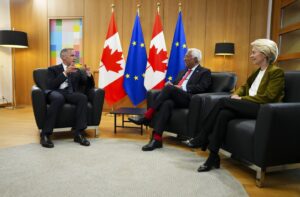
The result is a relationship that is progressively shaped not only by traditional diplomacy, but by the concept of strategic resilience. The proposal for EU-Canada associate membership, marks a fundamental shift in the scope and strategic vision of their bilateral relations.
However, this announcement is a starting point rather than a final deal, because “associate membership” has no existing legal blueprint within the EU, its structural, legal, and operational frameworks remain subject to future negotiation.
Ultimately, upcoming negotiations will test whether associate membership becomes a pioneering template for international alignment or remains largely symbolic.