
RECAP: Trump’s Recent Return to China, Rekindles Debate over a New US-China Bargain
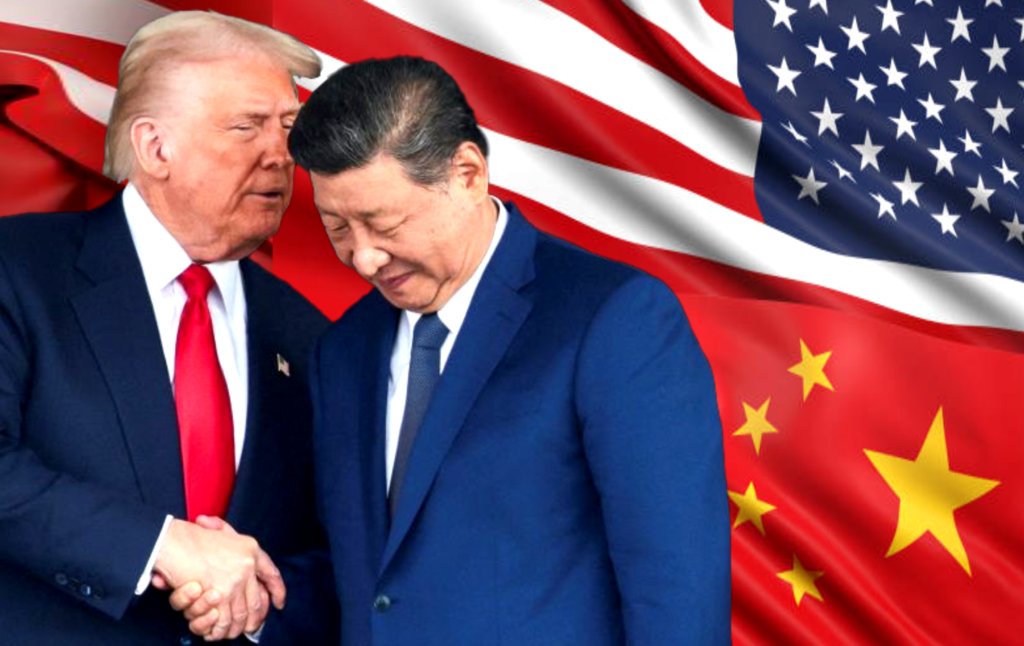
When US President Donald Trump arrived in Beijing alongside senior officials, family members, and some of America’s most influential business executives, the symbolism was difficult to ignore. Nearly a decade after his first high-profile visit to China in 2017. This is a trip that preceded years of tariffs, technology restrictions and strategic rivalry. Trump’s latest appearance has reignited global speculation, if Washington and Beijing are quietly searching for a new framework for coexistence.
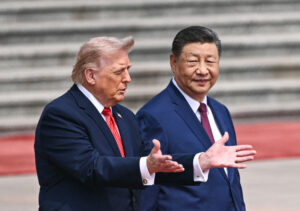
The visit, marked by meetings with Chinese President Xi Jinping at the Great Hall of the People, unfolded against a backdrop of deep geopolitical tensions; disputes over artificial intelligence, semiconductor exports, sanctions linked to Iran, military maneuvers in the Indo-Pacific, the growing competition over supply chains and financial influence. Even then, the composition of Trump’s delegation suggested that economics, rather than ideology alone, remains central to the relationship.
Executives linked to major American firms with profound commercial interests in China, including leaders from technology, aviation, finance and manufacturing, were highly visible during the trip. Their presence signaled that despite years of political hostility, large segments of global business still view US-China cooperation, as indispensable to economic stability.

Skirting the caption to focus on why the Trump-China’s visit matters; publicly, officials on both sides of the countries, continue to frame the relationship as competitive. Washington has tightened export controls on advanced chips, and imposed sanctions on Chinese entities accused of facilitating Iranian trade networks. Beijing in turn, has pushed back against what it describes as unilateral American pressure, while accelerating efforts to strengthen domestic innovation and reduce reliance on Western technologies. But underneath the confrontational rhetoric, lies a more complicated reality that the world’s two largest economies remain extremely intertwined.
American consumers depend heavily on Chinese manufacturing networks, while China’s export-driven economy, still relies significantly on access to Western markets and financial systems. This interdependence has created a paradoxical relationship that is defined simultaneously by rivalry and mutual dependence. Some observers now believe that both governments may be searching for a limited grand bargain; not a dramatic reconciliation, but a pragmatic attempt to prevent economic fragmentation from spiraling into global instability. Such a framework could include selective cooperation in finance, climate technologies, industrial investment and supply-chain management, even as competition continues in security and advanced technology. But hanging as a handbag, is the Taiwan question and strategic ambiguity.
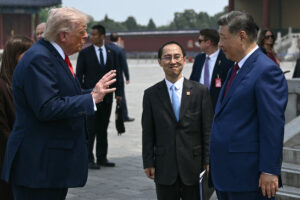
Taiwan remains as one of the most sensitive issues hovering over the visit. Since the 1972 Shanghai Communiqué, the diplomatic foundation that normalized relations between Washington and Beijing, is premised on what the United States has maintained in a policy that is described as strategic ambiguity. Washington recognizes the One China framework, while avoiding explicit commitments on how it would respond to a conflict involving Taiwan.
Some reviewers speculate that Trump could seek a more transactional approach, towards the issue; potentially linking security questions to economic negotiations. Though, such speculation may remain highly controversial and politically explosive, to both the United States and Asia. Also, regarding the 23 million Taiwanese residents, they see their position in this whole geopolitical calculations not as an abstraction, but questions of identity, democracy, security and everyday stability. Any abrupt change in the US policy, could reverberate across East-Asia and reshape regional alliances. Promoting the human impacts that is often overlooked in the picture as this.
While elite diplomacy dominates diverse features, the ordinary citizens in both countries continue to experience the consequences of prolonged tension. Chinese factory workers have faced job-uncertainty, as export markets fluctuate and multinational companies diversify production into Southeast Asia and elsewhere. In the United States, manufacturing communities that are promised economic revival through tariffs-policy, have seen mixed outcomes, with many businesses struggling under higher costs and disrupted supply chains. Students, researchers, diaspora communities, etc., have also been caught in the crossfire. Academic exchanges have narrowed. Visa restrictions and national security concerns, have fueled suspicion on both sides. Families with ties across the Pacific, increasingly find themselves navigating political mistrust that filters into their daily life.
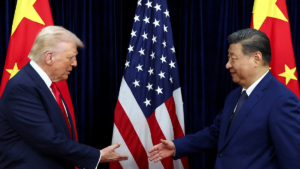
Meanwhile, developing economies particularly across Africa, Latin America and Southeast Asia, are watching carefully. Many governments do not want to choose between Washington and Beijing. Instead, they seek stable trade, infrastructure investment and diplomatic flexibility, in an increasingly polarized international system, which is scripting a creed of competing visions of global order. Thus, the bigger significance of Trump’s China visit, lies in what it reveals about competing visions of world order.
Beijing continues to promote initiatives tied to infrastructure connectivity and regional integration, including rail and trade corridors, stretching across Central Asia, towards Europe. Chinese policymakers view these projects as essential for long-term economic resilience and strategic autonomy. In the meantime, Washington remains concerned about preserving technological leadership, protecting supply chains and maintaining alliances across the Indo-Pacific.
Despite these competing ambitions, neither side appears capable of fully disengaging from the other, without severe global consequences. Financial markets, energy flows, consumer prices and technological innovation, are all firmly shaped by the US-China relationship. That reality may explain why economic officials and corporate leaders, increasingly play a central role in diplomatic encounters, once dominated primarily by security strategists.
The political atmosphere surrounding Trump’s visit, echoes a larger contradiction of the 21st century, a relationship defined by contradictions. Even so, the United States and China are strategic competitors that remain economically inseparable. The nationalist rhetoric in both countries, often portrays the relationship as a zero-sum struggle. Still behind closed doors, the mechanisms to manage risk, preserve trade flow and avoid open conflict, has been a continuous search through now, by concerned leading-actors.
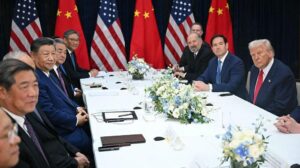
Ultimately, whether Trump’s latest visit produces meaningful agreements or merely symbolic gestures, is left in the hands of uncertainty. But the trip highlights a bigger truth that neither confrontation nor cooperation alone, fully defines US-China relations anymore. Instead, the relationship increasingly operates in a gray zone, where competition, negotiation, distrust and interdependence, coexist at the same time.
And for billions of people, whose livelihoods are shaped by the global economy, the fleshing-outcome of the meeting and what will happen between Washington and Beijing going forward, will continue to matter far beyond the walls of diplomatic meetings.